
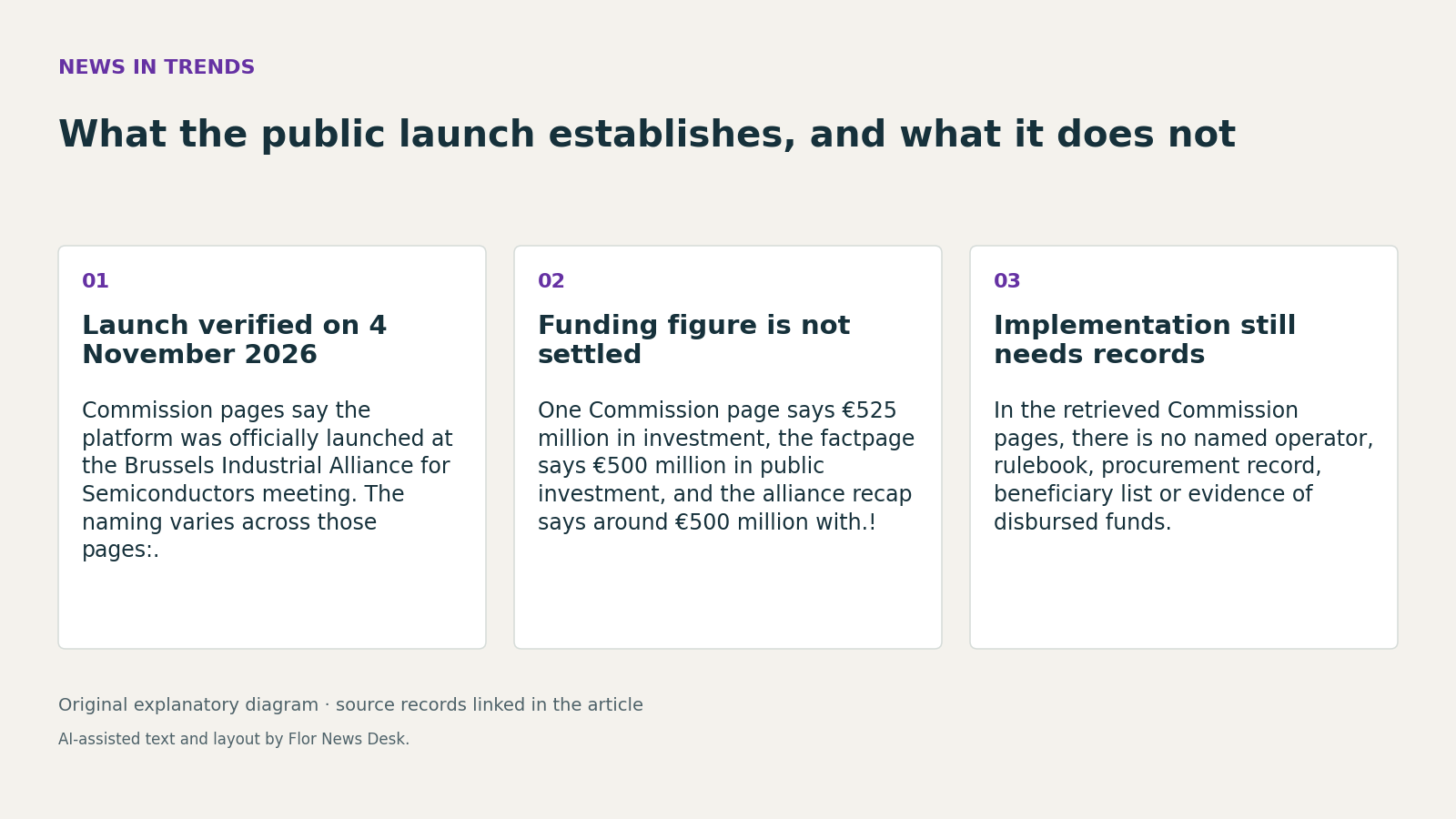
On 4 November 2026, the European Commission said it launched a new chip-design platform during the Industrial Alliance for Semiconductors meeting in Brussels. That much is clearly documented in the Commission’s own pages retrieved on 11 November 2026. What is less clear, from those same records, is how the platform will operate in practice and how much money is actually behind it. Commission news, updated 10 November 2026 Platform factpage, updated 4 November 2026 Alliance recap, updated 10 November 2026
The documented change is a service offer, not a new fabrication build or a published grant list. Across the three Commission pages, the platform is described as a cloud-based, one-stop shop meant to give start-ups access to design software, design enablement services, intellectual property blocks, training and access to manufacturing capacity. One page also frames it as access to finance. That makes this a design-side intervention in the semiconductor pipeline: the Commission is promising to lower the cost and complexity of getting from idea to chip design, before production begins. Platform factpage Commission news Alliance recap
The funding headline is where the Commission’s own record stops lining up neatly. The short Commission news item says the European Chip Design Platform “will mobilise €525 million in investment.” The factpage says “€500 million” will be mobilised in public investment. The alliance recap says the Commission is mobilising “around €500 million in public investment for the Platform, together with Member States.” That means the public record supports an announced funding range in Commission messaging, not one settled total. It also matters that the support bands do not appear on every page: the factpage and alliance recap say early-stage start-ups can receive up to €100,000 and more mature companies up to €16 million, while the shorter Commission news item does not include those bands. Commission news Platform factpage Alliance recap
The Commission’s rationale is consistent even when its figures are not. Its pages argue that Europe is weak in chip design, though they describe the benchmark slightly differently: one says European chip design companies account for less than 1% of global revenues in that segment, while another says Europe accounts for less than 1% of global fabless revenues. Either way, the institutional claim is that design capability is a bottleneck, and that stronger European design would create more demand for manufacturing capacity in Europe. What the retrieved pages do not provide is outcome data showing that the platform has already improved access, produced designs or secured fabrication for users. Commission news Platform factpage
That gap between launch and implementation is the most useful thing for readers to watch. In the retrieved Commission pages, there is no named platform operator, no published application terms, no selection criteria, no procurement record, no IP licensing detail, no signed beneficiary list and no evidence that funds have been disbursed. The pages also say users will get access to manufacturing capacity, but they do not show reserved capacity, partner foundries or booking terms. Those are the documents that would turn a policy launch into an operational programme. Platform factpage Commission news Alliance recap
There is also a source limit worth stating plainly: all three records here are European Commission pages. They establish that a launch was publicly announced on 4 November 2026 and that the Commission is presenting the platform as a Chips Act flagship. They do not, on their own, independently verify delivery. So the narrow, supported takeaway is still meaningful. Brussels has publicly moved some semiconductor policy attention toward who gets to design chips, not only where chips are made. The next decisive evidence will not be another summary page. It will be operational records.
Read our editorial standards or send a correction to the editorial desk.