
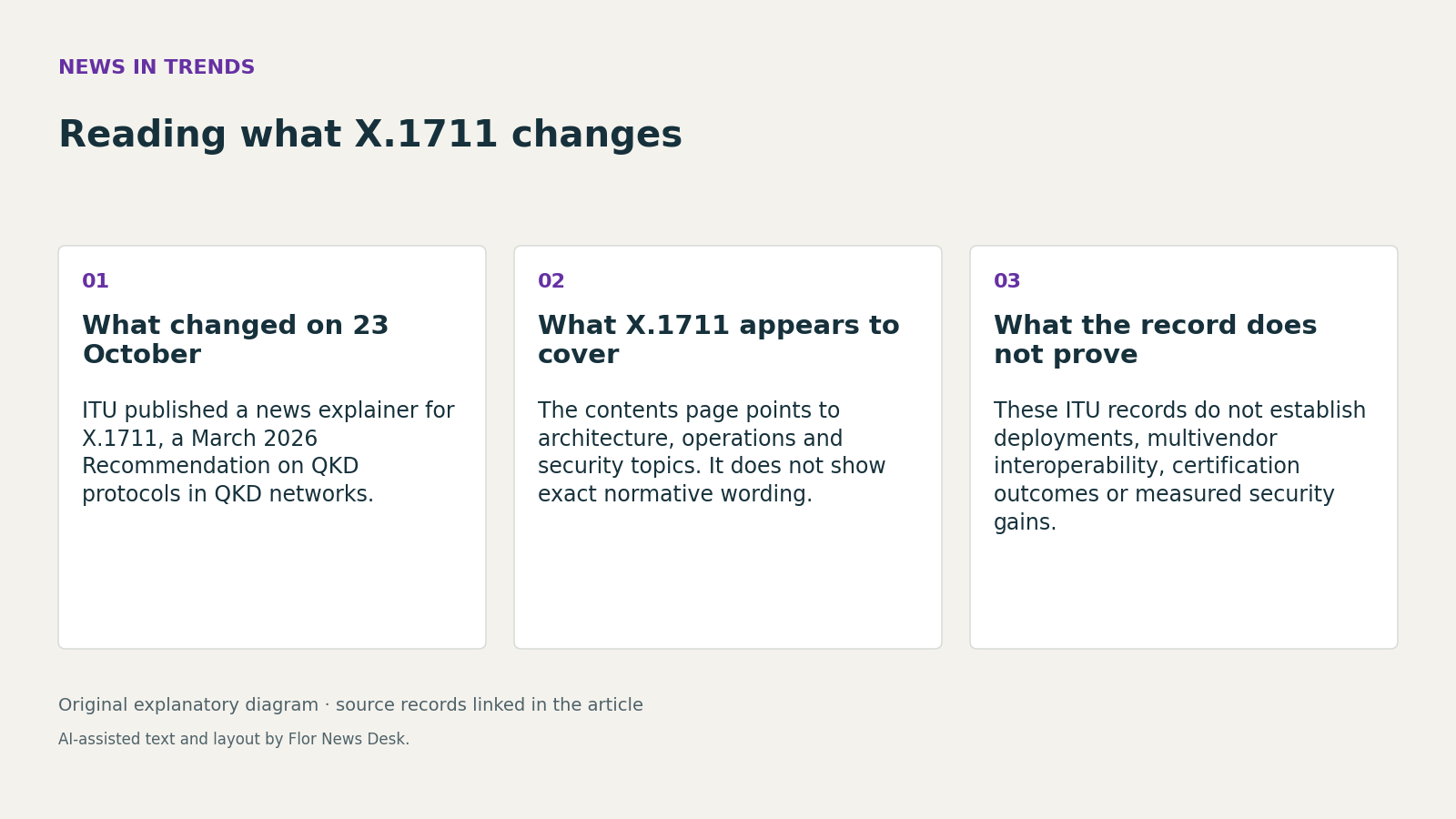
On 23 October 2026, the International Telecommunication Union used a news post to present Recommendation X.1711 as its reference point for protocols in quantum key distribution networks, months after the Recommendation appeared in March 2026 in ITU-T records. ITU says X.1711 does not choose one protocol; instead it sets out shared elements, a common architecture and an operational workflow for QKD protocols in QKD networks ITU news X.1711 contents. That is a real standards development, but it is not the same thing as evidence that operators are already running interoperable QKD systems.
The important change is organizational. ITU’s own account links X.1711 to QKD work spread across Study Group 11 on protocols, Study Group 13 on architecture and Study Group 17 on security, with activity going back to 2018 ITU news. Analysis: a named Recommendation that sits above those strands gives the institution a clearer internal reference for later documents. That matters because fragmented technical work can exist for years without producing a single public frame that outsiders can point to. What the source record supports, however, is the creation of that frame inside ITU’s standards system, not any broader market result.
The published table of contents helps show the Recommendation’s level of ambition. It lists sections on QKD protocol architecture and operations, then appendices on protocol categories, worked operational examples for decoy state BB84 and Gaussian modulation coherent state protocols, attack models in security proofs, quantum-proof randomness extraction, epsilon security and implementation security on QKD modules X.1711 contents. That looks less like a product certification document than a map of how protocol families, workflows and security concepts fit together. Just as important, this record is only a table of contents, so it cannot establish the Recommendation’s exact normative wording or how strict any requirement is.
ITU’s own write-up also signals that X.1711 is a starting layer rather than an endpoint. The 23 October post says future ITU standards could build on X.1711 to specify particular QKD protocols in more detail ITU news. That is a useful limit to keep in view. A framework that leaves room for later protocol-specific standards may help align terminology and design assumptions, but it does not by itself prove interoperability between vendors, successful field deployment, certification outcomes or measured security performance. The ITU post does not supply those results.
A comparison with another ITU post published one day earlier shows why readers should separate framework talk from implementation evidence. In a 22 October 2026 item about GENIE.AI, ITU described a platform it says was launched in July and said one-year pilots were approaching completion as of that publication date GENIE.AI post. X.1711’s QKD coverage uses different language: it describes a standard, its scope and future standards that may follow ITU news. Analysis: that contrast is a reminder that institutional publicity can bundle very different stages of maturity under the same broad idea of a framework.
So the strongest claim available from these records is narrow but still useful. ITU now has a public Recommendation, published in March 2026 and promoted on 23 October 2026, that organizes how it describes QKD protocols within QKD networks X.1711 contents ITU news. As of 5 November 2026, the records used here do not show whether that structure has produced interoperable systems, deployed networks or validated operational gains. Those are separate questions, and they need separate evidence.
Read our editorial standards or send a correction to the editorial desk.