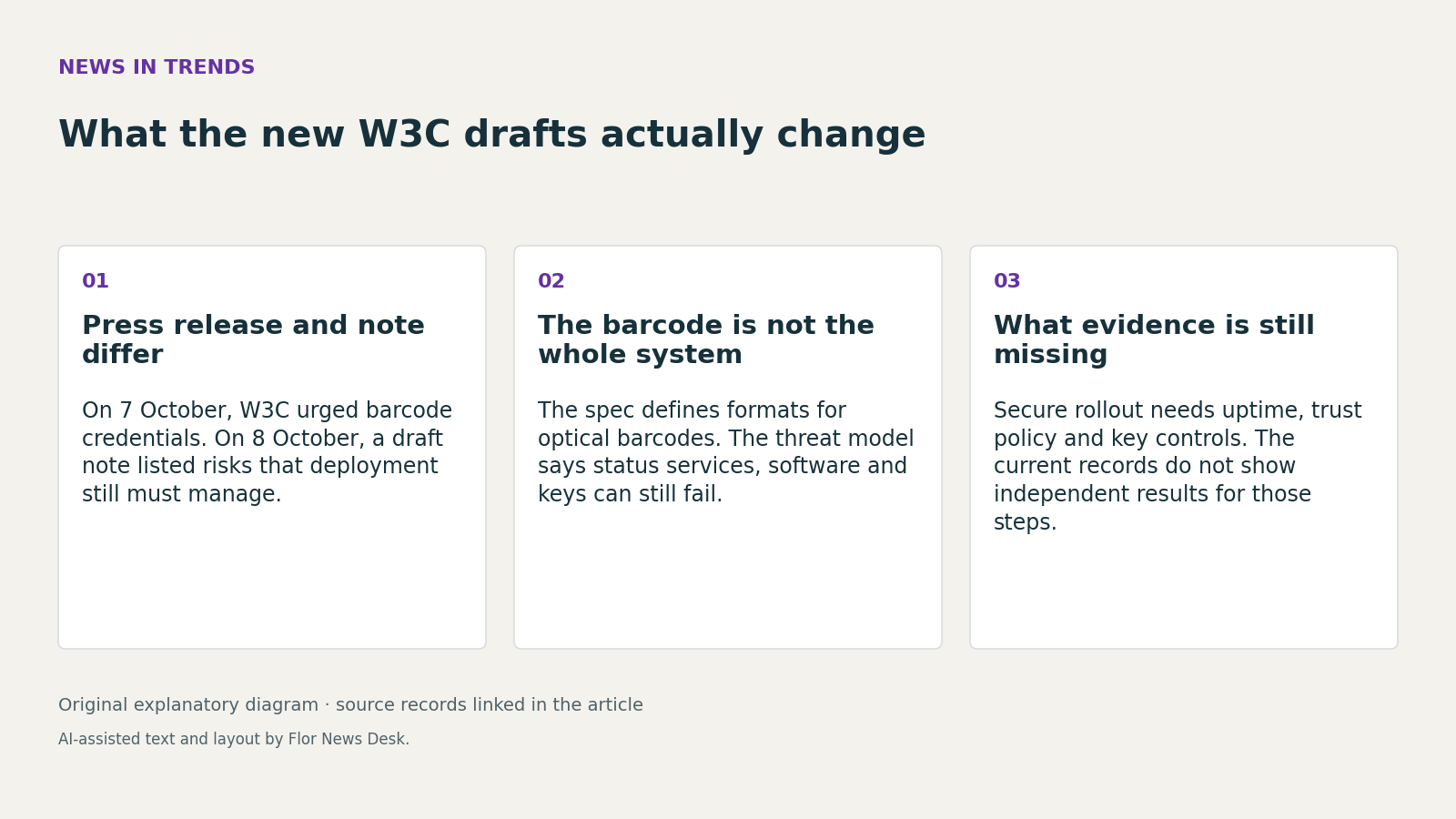
On 8 October 2026, the World Wide Web Consortium published Verifiable Credential Barcodes Threat Model v1.0, a draft note that changes how its own barcode-based identity push should be read. One day earlier, W3C had argued in a press release that copied images of identity documents can still pass signature checks and that barcode-based Verifiable Credentials with revocation support can reduce that risk (threat model, 8 October 2026; press release, 7 October 2026). The newer document does not refute that argument. It does show that the practical safety claim depends on systems and policies the barcode itself does not solve.
That distinction starts with document status. The threat model is a W3C Group Note Draft on the Note track and says it is still a work in progress, not an endorsed standard. By contrast, Verifiable Credential Barcodes v1.0 remains a Working Draft on the Recommendation track, defining how to encode credentials into optical barcodes on physical documents, including an OpticalBarcodeCredential form for signing over other machine-readable data on a card or page (threat model status; barcode spec; W3C draft-note announcement). In plain terms: one draft explains format; the other warns what can go wrong around that format.
The most consequential warnings concern revocation and uptime. The threat model names denial of service against status services and stale status caused by aggressive caching. It also says that, for revoked or suspended documents, high-assurance verifiers should reject a document when status results are missing or unreachable (threat model). That matters because the barcode spec makes credential status optional rather than universal (barcode spec). So a barcode can be cryptographically well-formed while a real deployment still fails the harder test: can the verifier reach fresh status information when the decision matters?
The privacy story is similarly narrower than a simple “scan and trust” pitch. The threat model explicitly lists correlation via status list retrieval as a risk, while the broader Verifiable Credentials Data Model v2.0 treats privacy as a design concern and says verification checks authenticity and current status, not whether every claim is true. That Recommendation also says verifiers must apply their own policies before relying on claims (threat model; VC Data Model 2.0). Analysis: if a verifier calls home for status on every scan, the anti-fraud mechanism can itself create a trail of who presented what, unless implementers add privacy-preserving retrieval choices the current records do not establish.
The draft note also names untrusted verification software and compromise of an issuer signing key as threats (threat model). Those are not edge cases. They mean the trust decision sits partly in scanner software, trust stores and key management, not just in a printed QR code. The core data model reinforces that point by defining issuer, holder, verifier and registry as separate roles rather than one self-securing object (VC Data Model 2.0).
That is why W3C’s strongest deployment language needs careful handling. The 7 October press release says the California Department of Motor Vehicles has issued new driver’s licenses and identification cards with a W3C Verifiable Credential Barcode since late 2025 and says the technology is already protecting millions of people (press release). From the source record here, that remains W3C’s institutional claim, not an independently demonstrated outcome. The same record does not establish independent interoperability results, uptime data, privacy testing or procurement requirements for verifier software.
A more defensible reading of the 7–8 October publications is this: W3C has made a stronger case that copied barcodes are not enough and that live status can matter, but it has also published evidence that barcode credentials are not a plug-and-play answer to stolen IDs. Before governments or vendors claim secure rollout at scale, readers should look for public evidence of resilient status services, explicit verifier trust policy, and auditable key-handling practice. The newly published documents show why those questions exist. They do not yet answer them.
Read our editorial standards or send a correction to the editorial desk.