

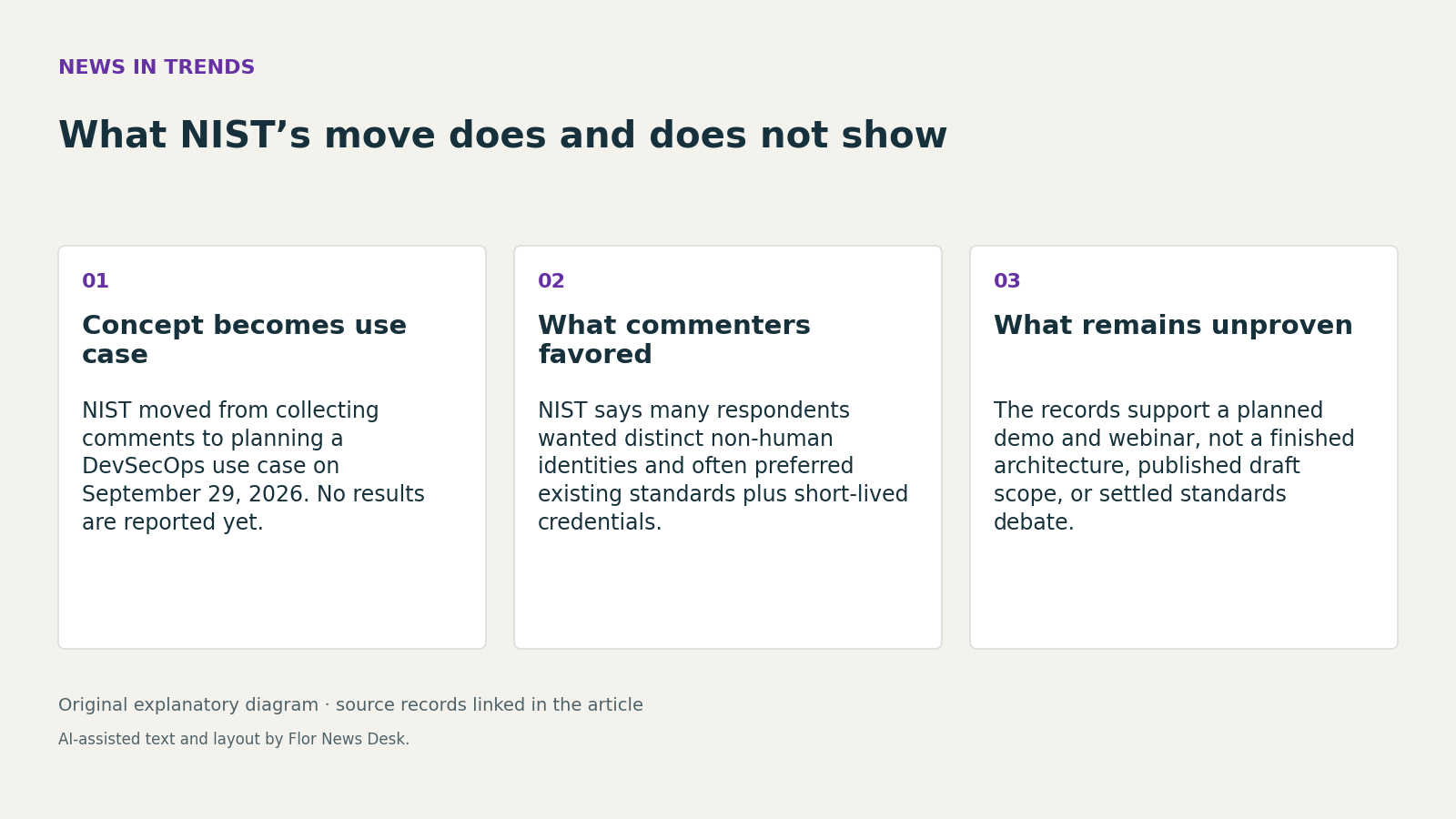
On September 29, 2026, NIST’s National Cybersecurity Center of Excellence said it had published a summary of more than 600 comments on its Software and Agentic Artificial Intelligence (AI) Identity and Authorization concept paper and chosen its Secure Software Development (DevSecOps) project as the first implementation use case for the work. That is a real change in posture. It is not evidence of a finished system, but it does move the project from consultation toward a specific engineering demonstration. (NIST news update)
The choice of DevSecOps matters because it narrows the question. NIST said that first use case will demonstrate how AI agents can be identified, authenticated and authorized in the software development lifecycle, while other use cases will be scoped later. In analytical terms, that makes the first test intentionally bounded. A hypothetical example: an agent that helps prepare a release could hold a durable identifier, then receive a short-lived credential for one task instead of open-ended authority. That reading fits the comment summary’s report that many respondents favored stable trust anchors combined with short-lived, task-scoped credentials. (NIST news update, summary of comments)
The most useful signal in the summary is that the public feedback did not simply call for a brand-new identity stack. On an undated NCCoE summary page available by October 2, 2026, the center says most commenters favored adapting existing identity standards and protocols for agentic systems. The same page says commenters broadly wanted agents to have distinct, verifiable non-human identities, yet did not reach consensus on one technical method. That combination helps explain why a demonstration comes before a final framework: it can test design choices without pretending the architecture debate is already over. (summary of comments)
NIST’s own taxonomy also keeps the discussion grounded. The summary groups deployments into enterprise-owned internal agents, enterprise-owned external-facing agents, and externally owned agents that interact with enterprise services. Those categories imply different trust boundaries and different failure cases. A DevSecOps demonstration may illuminate one slice of that map, but it cannot represent every setting in which software agents act for people or organizations. That is a scope limit visible in the record itself. (summary of comments)
The timeline remains more tentative than the phrase move to implementation might suggest. NIST’s September 29 announcement set a public webinar for October 28, 2026 and said additional use cases will be scoped later. The summary page says the NCCoE intends to release a draft project description covering proposed scope, use cases, architecture and standards. As of October 2, 2026, the supplied records do not establish that such a draft has been published or that any DevSecOps demonstration has produced results. (NIST news update, summary of comments)
Even the surrounding public discussion suggests why that restraint matters. Visible reader comments on a NIST cybersecurity blog page argue both that existing identity and access management approaches can be extended to agentic systems and that a new architecture may be needed. Those comments are not institutional findings, so they should not be mistaken for evidence of consensus. Still, they echo the tension in NIST’s official summary: broad agreement that software agents need accountable identities, paired with continuing disagreement over the exact machinery. (NIST cybersecurity blog page, summary of comments)
For readers, the practical takeaway is narrower and more useful than a broad claim about agentic AI. NIST appears to be starting where identity rules can be tested inside one controlled workflow. If that work succeeds, it should clarify one concrete part of the accountability problem in software delivery. On the current record, it cannot yet prove adoption, settle standards, or answer every cross-organizational trust question attached to agentic systems.
Read our editorial standards or send a correction to the editorial desk.