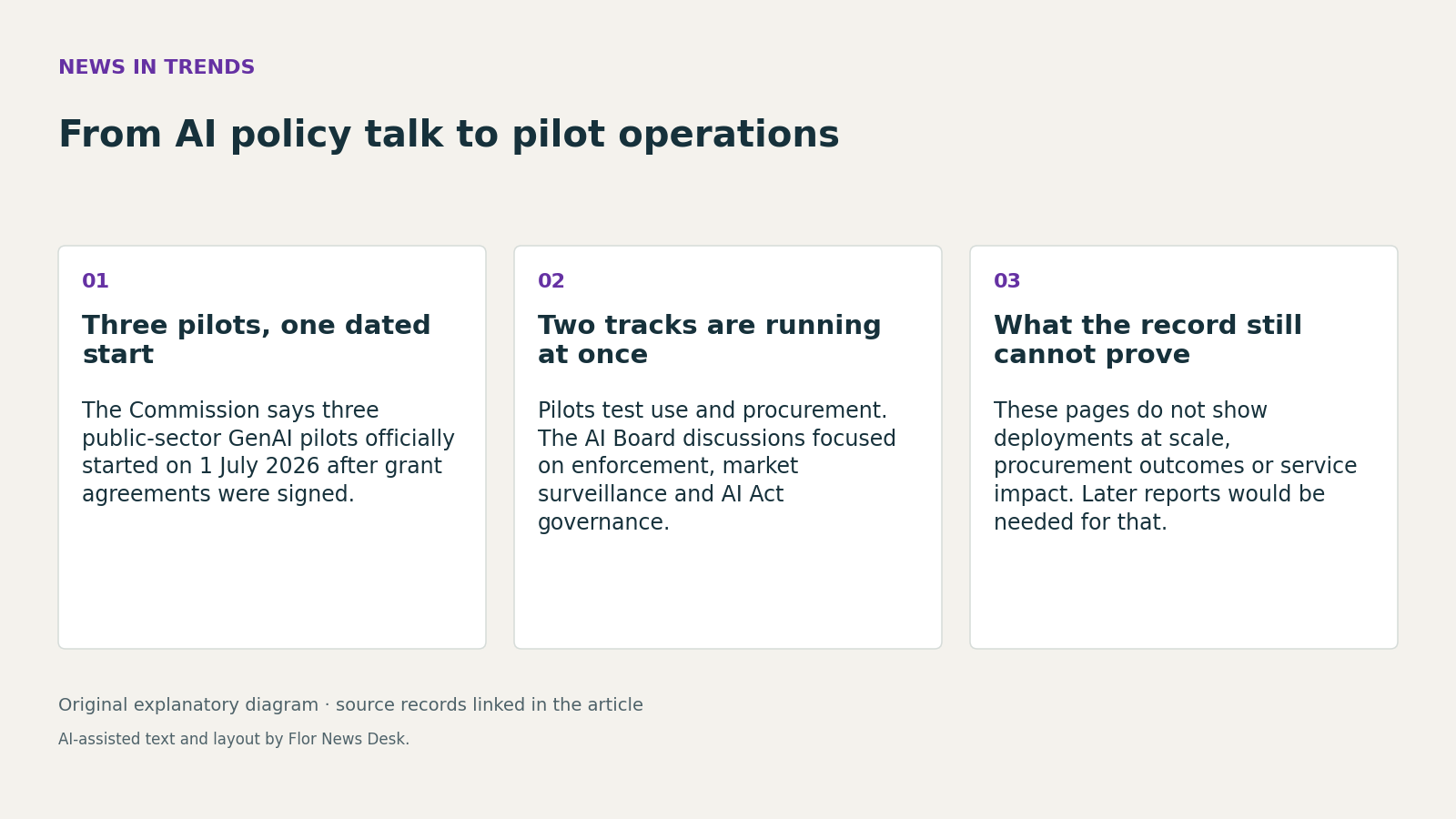
On 1 July 2026, the European Commission says three generative-AI pilot projects for public administrations officially started after grant agreements were signed: FLOODS & DROUGHTS, EUNOMIA.AI and EuropAI. That matters because it is a documented change in behaviour, not just another policy statement. The Commission is no longer only describing how public-sector AI should work; it is backing named projects under a Digital Europe Programme call on “GenAI for the public administrations.” Commission event page
What those pilots are meant to test is narrower, and more practical, than the larger rhetoric around AI sovereignty or continental competitiveness. According to the same Commission page, the projects are intended to help public administrations develop, procure, test and deploy European generative-AI tools for public-service needs, with planned discussion around procurement, sovereignty, startups and SMEs, and scaling across administrations. Commission event page But the source record here is limited. The pilot page is an event listing for 14 September 2026, and as of 26 September 2026 its “will host” wording is stale; it does not establish whether that meeting happened as planned, what was decided there, or whether any administration has yet bought or deployed anything.
The next visible step is not a procurement result but another implementation forum. The Commission scheduled a public-sector Apply AI webinar for 30 September 2026, describing it as a one-year stocktake after adoption of the Apply AI Strategy. Its agenda includes the AI Toolbox for public services, the Public Sector AI and Interoperability Readiness Pathway, or PAIR, and the new GenAI pilots. Apply AI webinar page That suggests the Commission is trying to turn separate tools, pilots and guidance into a common operating track for public administrations. As analysis, the important distinction is that this is about implementation scaffolding: a pathway, a toolbox and pilot projects. It is not yet evidence that administrations have reached interoperable deployment at scale.
At the same time, Brussels is tightening the governance side. The Commission says the AI Board met on 17 September 2026 and discussed enforcement activities, implementation updates, cooperation on market surveillance, pre-market conformity assessment under the AI Act and possible secondments for market-surveillance authorities to the European Data Protection Supervisor. It also says members were updated on transparency rules that became applicable on 2 August 2026. AI Board meeting summary That is a different lane from the pilots. One lane tests how public bodies might use generative AI. The other works on how the EU will supervise AI systems and coordinate enforcement. Treating them as the same thing would overstate the pilots. A pilot can inform future practice without proving legal compliance outcomes.
The Commission is also building a public stage for that two-track approach. It says the European AI Innovation Month will run from 14 October to 17 November 2026, culminating in an Apply AI Summit on 17 November in Brussels and online. European AI Innovation Month page Separately, the AI Board summary says a tenth Board meeting is expected on 18 November 2026 alongside that summit. AI Board meeting summary As of 26 September 2026, both are still planned events, not completed outcomes.
So the genuine story is not that Europe has proved public-sector generative AI works. It is that the Commission has moved from principles and voluntary preparation into funded pilots plus a more explicit implementation calendar. That is enough to mark a new phase. It is not enough to claim adoption, savings, better services or settled compliance. The next useful evidence will be more concrete: published pilot deliverables, procurement choices, interoperability testing records, or formal AI Board decisions. None of those are established by the current pages alone.