

W3C’s public agenda for TPAC 2026 shows a concrete change in how it is handling AI-related web questions: by late October, ideas discussed in a September seminar had been turned into named breakout proposals inside the consortium’s main annual coordination meeting. W3C says TPAC 2026 runs from 26 to 30 October in Dublin, Ireland, with hybrid participation, and describes it as its major annual event for coordinated work across technical groups and governance bodies (TPAC 2026; TPAC breakout calendar).
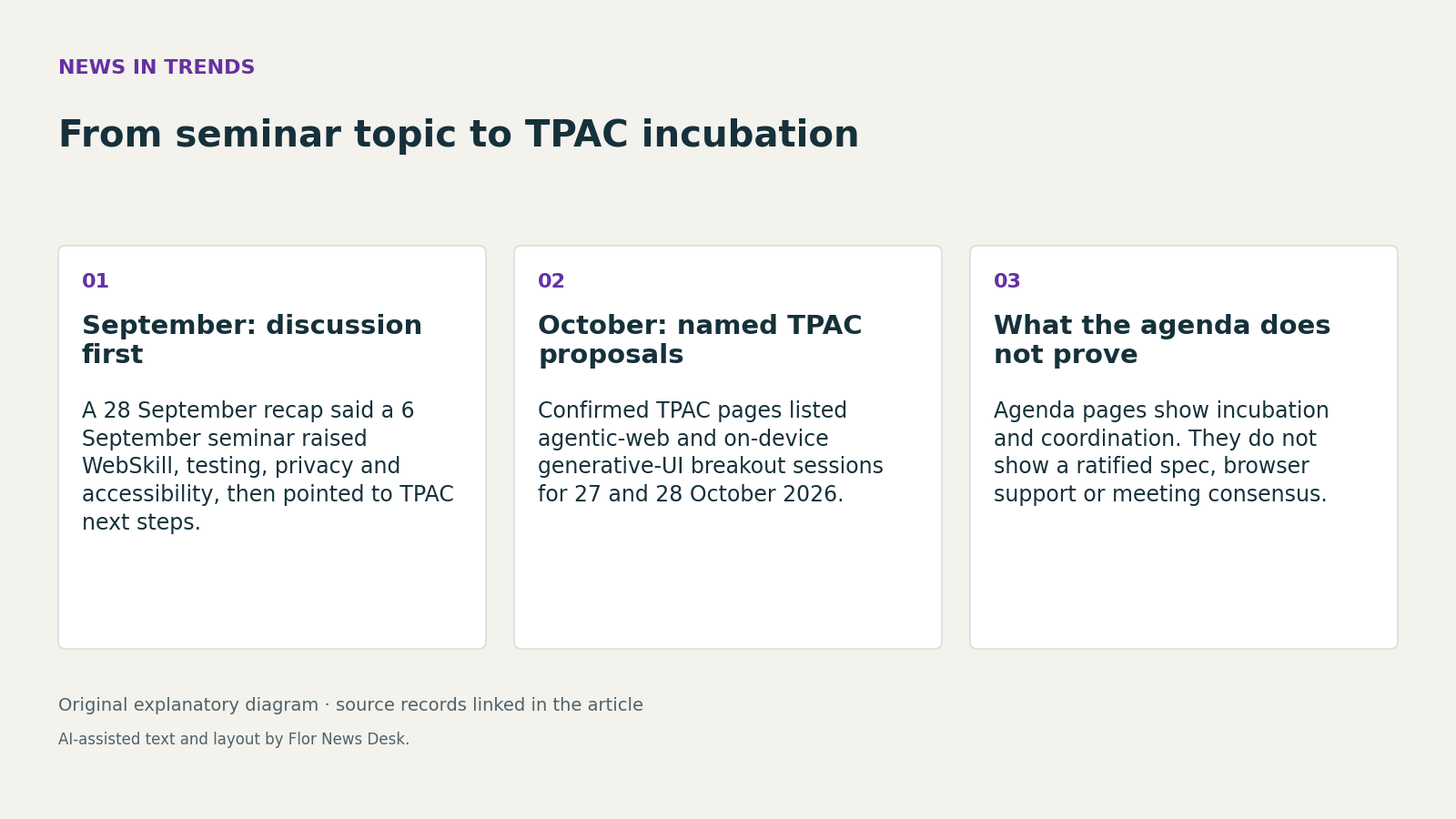
That change matters because standards work begins long before a formal specification is approved. In a recap published on 28 September 2026, W3C said a 6 September seminar in Shenzhen covered interoperability, accessibility, privacy, security, validation and testing for generative UI and WebSkill, and that the next step would be TPAC breakout sessions, Community Group discussions and other community activity (seminar recap). On its own, that was only an expectation. The October TPAC pages are the stronger record that the discussion did move into W3C’s working machinery.
One of those pages lists a confirmed 28 October TPAC breakout titled On-Device Generative UI Application Profile, proposed by Martin Alvarez-Espinar and Jing Shen (On-Device Generative UI Application Profile). The proposal frames a technical trade-off between web-engine approaches and native JSON approaches, then sketches three layers for exploration: a constrained Generative UI Baseline syntax, a Lightweight Web Engine and OS-Unified Rendering. The important point is not that W3C endorsed that stack. It is that a specific architecture has been put forward for community feedback inside a standards venue.
A second confirmed TPAC breakout, Agentic Web: declarative and imperative solutions, was listed for 27 October with Marcos Caceres as proposer (Agentic Web: declarative and imperative solutions). Its description says browser engines are already taking somewhat different approaches to how agents interface with web content, and warns that alternative imperative approaches could increase fragmentation and create accessibility, privacy and security risks. That framing signals where the dispute is likely to be: not whether agents exist, but how much of their behavior should be standardized declaratively versus left to vendor-specific tooling.
The seminar recap adds another layer. W3C says Chunhui Mo presented WebSkill as a browser-based declarative contract with self-contained execution, privacy isolation, client-side storage in Origin Private File System and scripts running in a Web Worker sandbox, and that participants expressed interest in continued discussion on WebSkill incubation and a quality monitoring and evaluation framework for generative UI (seminar recap). Read together with the TPAC agenda, that suggests two linked tracks: how agent-capable components are packaged and run, and how generative interfaces are rendered and governed on the web.
The limits of the public record are just as important as the shift it documents. The TPAC event pages are agenda entries and proposals, not approvals, charters or implementation commitments (On-Device Generative UI Application Profile; Agentic Web: declarative and imperative solutions). W3C also says TPAC is not open to the press because it is a working meeting, although most records are later made public online (TPAC 2026). So the current evidence shows incubation and cross-group coordination, but not whether any room reached consensus, whether a Community Group will be launched, or whether any browser vendor will implement the ideas.
That leaves a narrower but still useful conclusion. As of 30 October 2026, the clearest documented move is organizational: W3C has taken generative UI and agentic web issues out of standalone discussion and placed them inside TPAC’s standards workflow. For developers, browser teams and accessibility or privacy specialists, the next meaningful signals will be public minutes, charters, test work or implementation plans. None of those are established by the agenda pages yet.
Read our editorial standards or send a correction to the editorial desk.