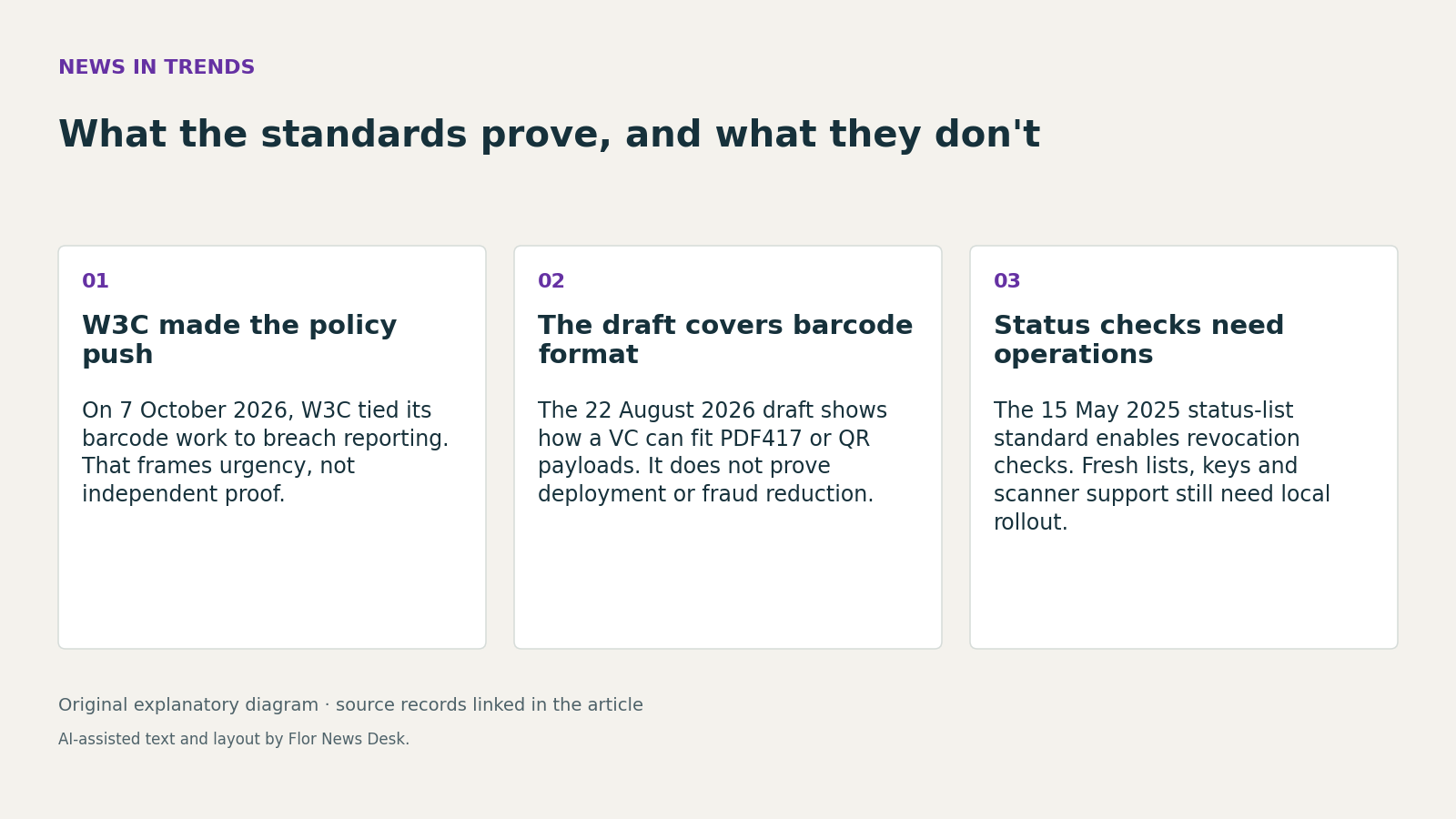
On 7 October 2026, W3C tried to turn an identity-security scare into a standards argument. In a press release, the consortium said September 2026 reporting had uncovered a dark-web market selling access to scans of about 160 million driver's licenses from the United States and Canada, with early reporting suggesting a compromised identity-document verification service. W3C's case is that a signed barcode alone is not enough if thieves can replay a stolen image of the document; the missing piece is a status check that can invalidate an individual credential after compromise (W3C press release, 7 October 2026).
The strongest part of that argument is technical, not evidentiary. The 22 August 2026 Working Draft for Verifiable Credential Barcodes shows how a verifiable credential could be carried in optical forms already familiar to government IDs, including PDF417 barcodes on driver's licenses and machine-readable zones on travel documents. The draft says the payload is a verifiable credential secured with Data Integrity and compressed with CBOR-LD, and it defines an OpticalBarcodeCredential for either adding a credential-bearing barcode or protecting selected data already present on a document. For machine-readable-zone use, it specifies a QR encoding path using base45-multibase text prefixed with VC1- (Verifiable Credential Barcodes v1.0, Working Draft, 22 August 2026). That is a concrete design for fitting signed credentials into barcode-constrained media. It is not, by itself, proof of deployment, interoperability at scale, or fraud reduction.
Revocation is where the proposal becomes more than a signed sticker. The 15 May 2025 Bitstring Status List Recommendation defines a compressed status list that lets a credential point to a URL and an index, so a verifier can check whether that entry has been marked for revocation, suspension, refresh or message. The standard requires a minimum expanded list size of 131,072 entries, and it advises verifiers to cache lists and use proxies or similar mechanisms to reduce issuer visibility into retrieval patterns (Bitstring Status List v1.0, Recommendation, 15 May 2025). The implication is important: the privacy story depends on distribution choices as much as cryptography. A status list can avoid a live issuer lookup for every scan, but freshness still turns on how lists are published, cached and rotated, and on who controls signing keys.
The base trust model is narrower than some marketing language suggests. Verifiable Credentials Data Model v2.0, also a W3C Recommendation dated 15 May 2025, defines a credential as tamper-evident and cryptographically verifiable, with roles for issuer, holder, verifier and a verifiable data registry. It also states that verification checks authenticity, conformance, the securing mechanism and status if present, but does not establish that a claim is true in the broader social sense (Verifiable Credentials Data Model v2.0, Recommendation, 15 May 2025). In plain terms, this stack can help answer whether a barcode came from an issuer and whether it has been revoked. It does not settle identity-proofing quality, scanner rollout, accessibility, or local rules for when a verifier should trust the result.
That is why the most consequential sentence in W3C's press release is also the least verified in this record set: W3C says the California Department of Motor Vehicles has issued driver's licenses and identification cards with a W3C Verifiable Credential Barcode since late 2025 (W3C press release, 7 October 2026). None of the retrieved technical documents independently confirms that claim, names a production status-list endpoint, or shows measured outcomes after deployment. For officials and vendors, the useful next questions are practical: where are the procurement or implementation records, how are signing keys governed, how often must verifiers refresh status lists, what happens on legacy scanners, and what accessibility testing exists for people who cannot reliably present or scan the barcode. The standards describe a plausible route to revocable physical credentials. The public evidence here does not yet prove that the route is already working at statewide scale.
Read our editorial standards or send a correction to the editorial desk.