

On 10 and 11 November 2026, UNESCO moved its AI-and-education agenda into a more operational phase. It published an AI-focused companion to its Media and Information Literacy work and separately announced the start of a large teacher-training programme in Nigeria. Those are different kinds of evidence, but together they show a shift from describing the need for AI literacy to packaging material and scheduling delivery UNESCO curriculum launch UNESCO Nigeria training announcement.
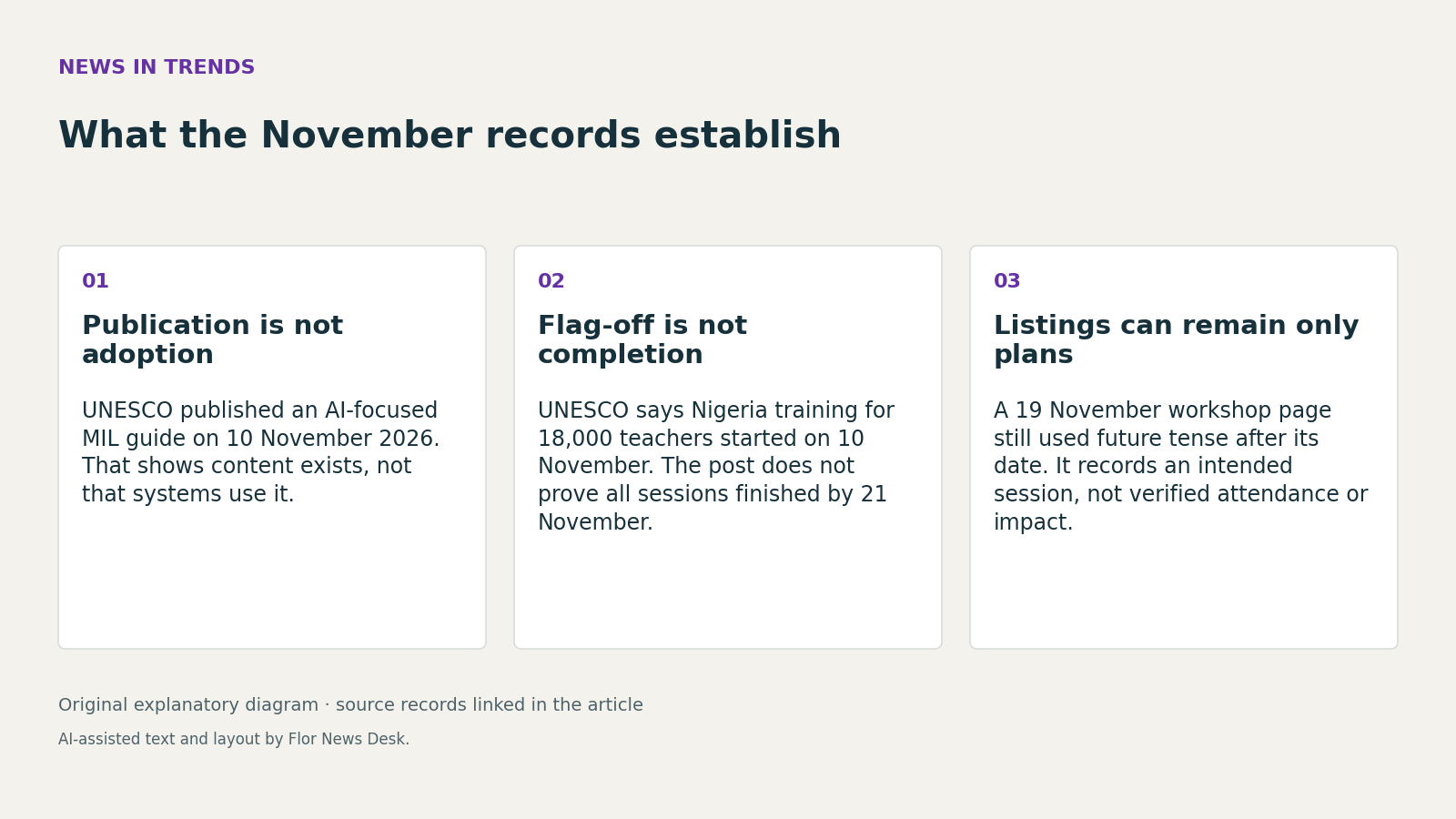
The publication step matters because UNESCO is not presenting the new guide as a list of tools. According to UNESCO, AI Answers. You Decide. is aimed mainly at educators, teacher-training institutions and curriculum developers, and it covers five areas including AI and the media, AI and power, and AI and human rights. UNESCO also describes it as a companion to its 2021 Media and Information Literacy Curriculum rather than a replacement for that earlier framework UNESCO curriculum launch. The analytical point is narrower than the launch language: publication shows UNESCO has defined content for AI-mediated information environments, but it does not show that any ministry, school system or teacher-training body has adopted it.
The Nigeria programme is a stronger sign of implementation because UNESCO attaches it to dates, places and scale. UNESCO says it, the European Union and the Government of Katsina State flagged off training for 18,000 teachers on 10 November 2026 across Adamawa, Bayelsa, Enugu, Katsina, Oyo and Plateau. The post says activities began that day and were scheduled to run through the end of November, using 13 modules and building on an assessment of more than 10,000 teachers. UNESCO attributes the effort to the second phase of the Education and Youth Empowerment Initiative in Nigeria, funded by the European Union and implemented by UNESCO UNESCO Nigeria training announcement. As of 21 November 2026, though, that record still does not establish completion, attendance totals, funding amount, or measured changes in classroom practice.
A third UNESCO record shows how easily operational signals can blur into uncertainty when source wording goes stale. A 19 November 2026 event page from UNESCO’s Regional Office in Santiago and CodeAI advertised a Spanish-language online workshop for teachers in Latin America and the Caribbean, linked to UNESCO’s AI competency framework for teachers and built around a hands-on exercise called AI for Oceans UNESCO workshop listing. But because that page is an event listing and still uses forward-looking language even though 19 November is now past, it documents intent, not verified participation or impact.
The broader UNESCO ecosystem also looks more active than a single launch might suggest. UNESCO’s Institute for Information Technologies in Education keeps an AI-in-education theme page that lists the 10 November companion guide, a 28 September 2026 report on Teacher AI Competency Frameworks, and 12 October 2026 micro-learning courses on generative AI for higher-education teachers UNESCO IITE AI in education index. That index supports a pattern: frameworks, self-paced courses, workshops and conference activity are being assembled in parallel. It does not, by itself, verify how far any of those offers reached into national systems.
That distinction is the real story for readers tracking AI literacy. UNESCO’s November record shows content production and training logistics becoming more concrete. What it does not yet show is the harder part: whether published guides become official curricula, whether flagged-off training reaches all intended teachers, and whether any of it changes what students learn about AI, media and power. For now, the documentary shift is from guidance toward rollout. The proof of results is still missing from the public record.
Read our editorial standards or send a correction to the editorial desk.