

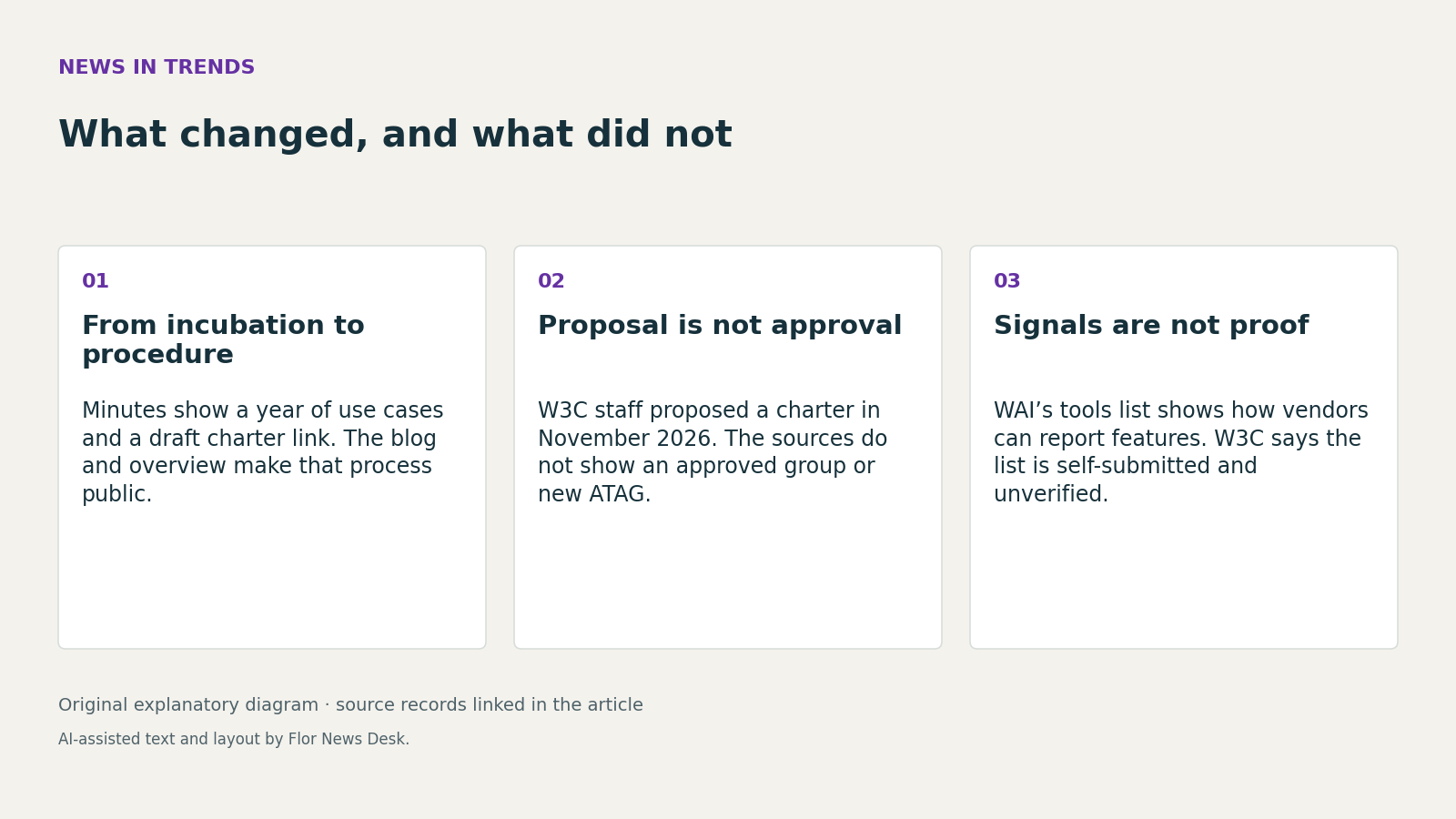
W3C’s accessibility work around authoring tools became more concrete on 10 November 2026, when a Web Accessibility Initiative blog post urged tool developers and other stakeholders to engage with an ATAG update effort and pointed them to participation channels (WAI blog post). The current ATAG overview page also says that, in November 2026, W3C staff proposed a new charter for an ATAG Working Group as a joint W3C–Accessibility Standards Canada standard (ATAG overview). That is a meaningful procedural step. It is not, on this record, a new standard, an approved Working Group, or evidence that products have already changed.
The substance of the push is easy to miss if ATAG sounds like a niche standards acronym. The overview page says ATAG 2.0 is a W3C Recommendation covering both the accessibility of authoring tools themselves and the ways those tools should help people produce content that conforms to WCAG (ATAG overview). The 10 November blog argues that this matters because large volumes of web content now pass through social platforms, content-management systems, learning-management systems and no-code builders, and it lists practical examples such as prompting for alt text, limiting color choices to WCAG-conforming options and shipping accessible components (WAI blog post). The analytical point is broader: W3C is trying to move accessibility upstream, from after-the-fact checking toward default tool behaviour.
Generative AI is part of why the timing has changed. Minutes dated by URL to 28 October 2026 record participants pointing to generative AI, large language models and faster content production as reasons to revisit guidance for authoring tools (ATAG Community Group minutes). The 10 November blog makes the same case more publicly and cites an estimate that 74% of new web pages in April 2025 included AI-generated content (WAI blog post). That statistic comes through an advocacy-style post and is not independently verified here, but the institutional logic still holds: if more content creation happens inside AI-assisted tools, accessibility policy has a stronger reason to target those tools.
The public record also shows a shift from incubation to process. The October minutes attribute to Wendy Reid the view that the ATAG Community Group had spent about a year developing use cases and requirements for ATAG 3, and they record discussion of a possible ATAG 2.1 refresh that would update links and terminology without normative changes (ATAG Community Group minutes). Near the end of the same minutes, Shawn is recorded saying a draft charter was ready for review, and the page includes a link to that draft charter (ATAG Community Group minutes). The overview page now mirrors that trajectory by referring to a proposed charter, although the fetched page does not display an explicit update date for when that language was added (ATAG overview).
What stakeholders can act on immediately is narrower than the rhetoric. The blog asks developers to participate in the community group, review ATAG materials and submit tools to WAI’s Authoring Tools List (WAI blog post). That list is structured around ATAG-style questions, including whether a tool generates accessible markup, preserves accessibility information, guides editors and checks accessibility automatically (Authoring Tools List). But W3C also says the information is self-submitted, unverified and incomplete, and the visible entries in this retrieval are only five tools, with the newest shown as Wagtail v7.4, updated on 6 May 2026 (Authoring Tools List). For procurement or compliance teams, that makes the page a signal source, not a certification register.
As of 13 November 2026, the evidence supports a clear but limited conclusion. W3C WAI has made ATAG updating more visible, linked it to AI-era authoring tools and exposed a route toward formal standards work (WAI blog post; ATAG overview; ATAG Community Group minutes). The same record does not establish when a charter will be approved, whether ATAG 2.1 or ATAG 3 will advance first, or whether vendors will adopt any new guidance. That gap is exactly why this procedural moment matters: it is the point where accessibility expectations can start shaping tool roadmaps before any rule is final.
Read our editorial standards or send a correction to the editorial desk.