

On 10 November 2026, the International Telecommunication Union gave network resilience its own high-level ministerial discussion at PP-26 in Doha, after the conference opening page had already listed infrastructure resilience among the subjects shaping ITU’s next period of work through 2031. That is a documented change in emphasis: resilience was not treated as a side note to connectivity, but as a headline topic for ministers and senior executives at the conference itself. The relevant public records are the ministerial programme page for the session and the 9 November opening summary for PP-26. High-level Thematic Discussion on Resilience PP-26 opens in Doha
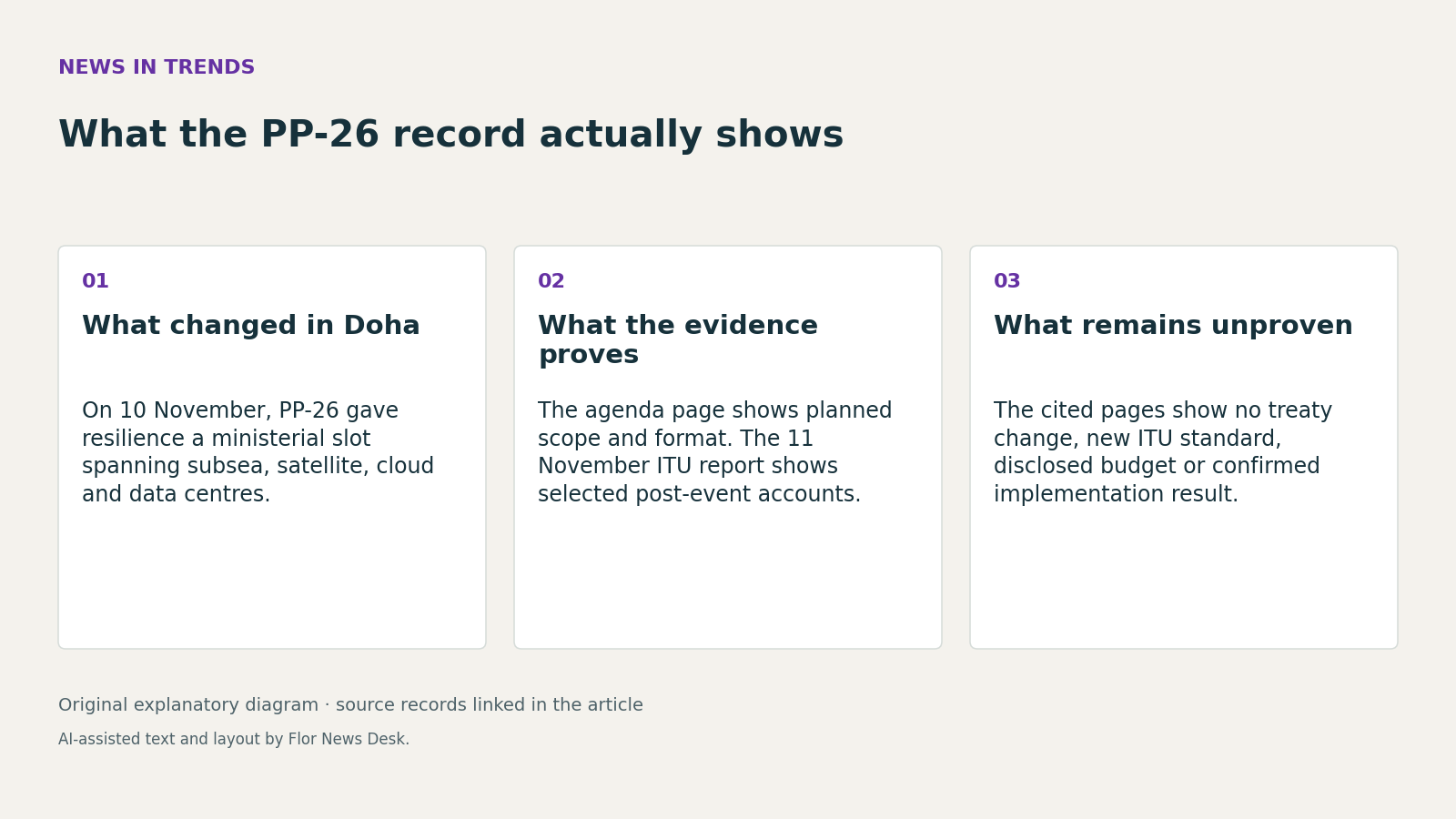
The ministerial programme page matters because it shows how ITU framed the problem before or during the event. It scheduled a closed-door session for 14:30 to 17:30 on 10 November 2026, limited speaking slots to ministers, high-ranking delegates and invited executives, and set an agenda that tied continuity not just to cyberattacks but also to extreme weather, power failures, subsea cable disruption, satellite disruption and geopolitical risk. It also explicitly linked terrestrial, satellite, subsea, cloud and edge networks. As checked on 12 November 2026, that page still reads like a future-tense agenda, so it proves planned scope and format, not what participants actually agreed. High-level Thematic Discussion on Resilience
The only post-event account in the cited record is an ITU Hub report published on 11 November 2026. It says the 10 November discussion examined resilience across terrestrial, satellite and subsea networks, cloud, data centres and critical Internet infrastructure. It also attributes to ITU Deputy Secretary-General Tomas Lamanauskas a set of scale markers: 6.3 billion people online, roughly 99 per cent of international data traffic moving through submarine cables, and 150 to 200 cable breaks each year. Those figures help explain why resilience was elevated politically. But the page is still an institutional news summary, not a transcript, vote record or adopted text. Network resilience: Design for disruption
The most concrete policy material in that ITU summary is not a new global rule. It is two national examples. ITU says 2026 telecom licence renewals in the United Arab Emirates made resilience a regulatory obligation, citing the UAE Telecommunications and Digital Government Regulatory Authority. It also says Saint Vincent and the Grenadines described the communications damage from Hurricane Beryl in July 2024 and its assessment of critical infrastructure while working with Grenada on a submarine cable project with satellite backup links. Read narrowly, those examples show the tools already in play: licence conditions, infrastructure assessment and backup design. They do not show that PP-26 adopted those tools for anyone else. Network resilience: Design for disruption
The same distinction applies to the technical ideas attached to the discussion. The ITU Hub report says private-sector speakers raised AI for anomaly detection and maintenance, warned about AI-driven pressure on telecom and power systems, and argued for quantum-safe security standards. The ministerial agenda page separately ties resilience to ITU’s mandates around interoperability, cybersecurity, emergency communications and continuity of essential services. Taken together, the records show a broad agenda pressing on telecom, cloud and security at once. They do not show a new ITU Recommendation, a standards work item approved at PP-26, or a binding mandate to produce one. Network resilience: Design for disruption High-level Thematic Discussion on Resilience
That leaves a practical reading for operators and policy watchers. As of 12 November 2026, the cited public pages support a political signal, not an enforceable conference outcome. The opening-day summary says ITU leadership elections began on 12 November and that strategic and financial decisions for 2028-2031 would follow later, which means those later decisions were still pending in this record. The Hub report also says Lamanauskas announced a first Global Digital Resilience Forum in Dubai for 8-9 December. Those are milestones to watch, but neither page establishes what PP-26 eventually adopted. PP-26 opens in Doha Network resilience: Design for disruption
The clearest conclusion from the sourced record is modest but important. On 10 November 2026, resilience was staged as a minister-level, cross-stack issue inside ITU’s top policy conference. That can shape how governments and vendors frame upcoming licence renewals, procurement language or standards lobbying. It is not, on the evidence cited here, a treaty amendment, a budget line or a finished technical rule.
Read our editorial standards or send a correction to the editorial desk.