
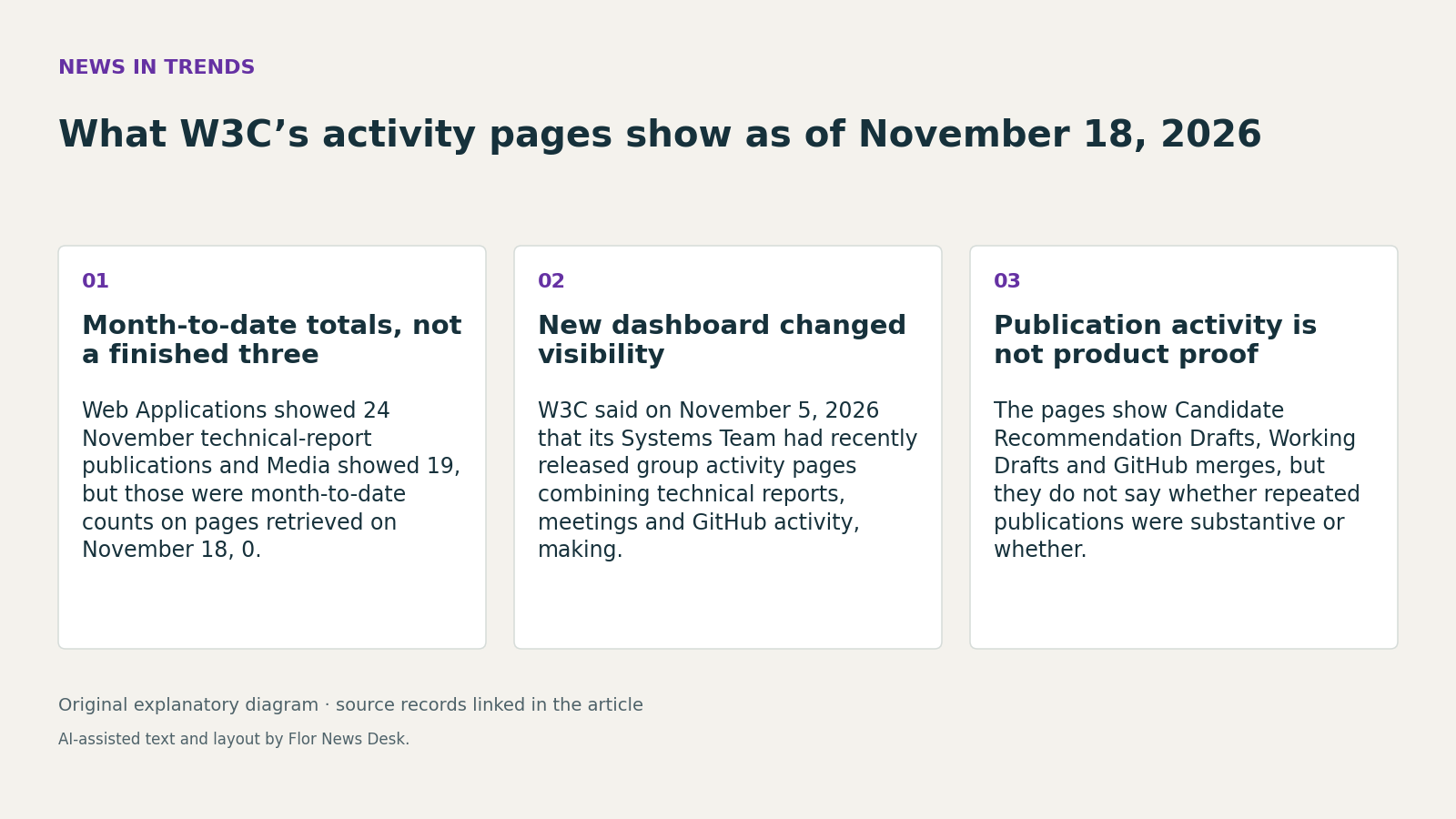
As of November 18, 2026, W3C’s new beta group activity pages were making a busy stretch of standards publishing unusually easy to see. The Web Applications Working Group activity page showed “November 2026 TR publications” with 24 documents published and a latest publication date of November 18, 2026. The Media Working Group activity page showed 19 documents published in November, with a latest publication date of November 17, 2026.
That is a useful signal, with an important limit. Those 24 and 19 figures are month-to-date November totals, not counts confined to November 16–18. And because the pages were retrieved on November 18, the same-day entries were still provisional rather than a finished three-day window.
Even with that caveat, the clustering is real enough to matter for readers who track web standards process. On the Web Applications page, Device Orientation and Motion was listed as published twice as a Candidate Recommendation Draft, with its latest publication on November 18, 2026. Geolocation was listed three times, also as a Candidate Recommendation Draft, with its latest publication on November 18. Service Workers Nightly appeared as a Candidate Recommendation Draft on November 17. Web Application Manifest was listed four times as a Working Draft, latest November 18. On the Media page, WebCodecs was published four times as a Working Draft, latest November 17; Autoplay Policy Detection twice, latest November 16; and Media Session twice, latest November 14. See the Web Applications activity page and Media activity page.
The mix of statuses matters. Candidate Recommendation Drafts and Working Drafts are not the same stage. The activity pages also do not say whether repeated publications were editorial refreshes, process republications or larger technical revisions. So the record supports a dense run of published texts, not a claim that browsers shipped features, interoperability improved or adoption followed.
Visibility is part of the story too. In the W3C Newsletter - October 2026, published on November 5, 2026, W3C said its Systems Team had “recently released activity pages” aggregating GitHub activity, meeting information and technical-report publications across 46 Working Groups, 12 Interest Groups and 194 Community Groups. The newsletter also said a TPAC breakout drew requests for improvements and additional features. That means this November cluster is easier to detect partly because W3C changed the public dashboard, not only because working groups were active.
The contrast with the broader W3C 2026 news archive helps explain why. On the retrieved page, the newest visible item was a November 17, 2026 notice about the Technical Architecture Group election, and the page stated it was showing only results 1–10. That limited archive view cannot prove related specification items were absent elsewhere, but it does show why group-level pages may now be the clearer place to watch day-to-day standards output.
The same beta pages also bundle GitHub logs beside publication counts, but those logs need careful reading. The Web Applications page listed nine merged pull requests in w3c/push-api during November and five merged pull requests in w3c/ServiceWorker on November 17. The Media page listed seven merged pull requests in w3c/webcodecs during November, including merges on November 17. Some entries look technical; others are plainly editorial or administrative, including several “chore” changes. That supports a picture of active maintenance around a publication-heavy month, but not a clean measure of implementation progress.
For readers following the web platform, the narrower takeaway is the stronger one: by November 18, W3C had a new public way to expose working-group tempo, and that view showed a dense November run of technical-report publications across adjacent platform areas. What the public record still does not establish is product rollout, test results or adoption outcomes.
Read our editorial standards or send a correction to the editorial desk.