
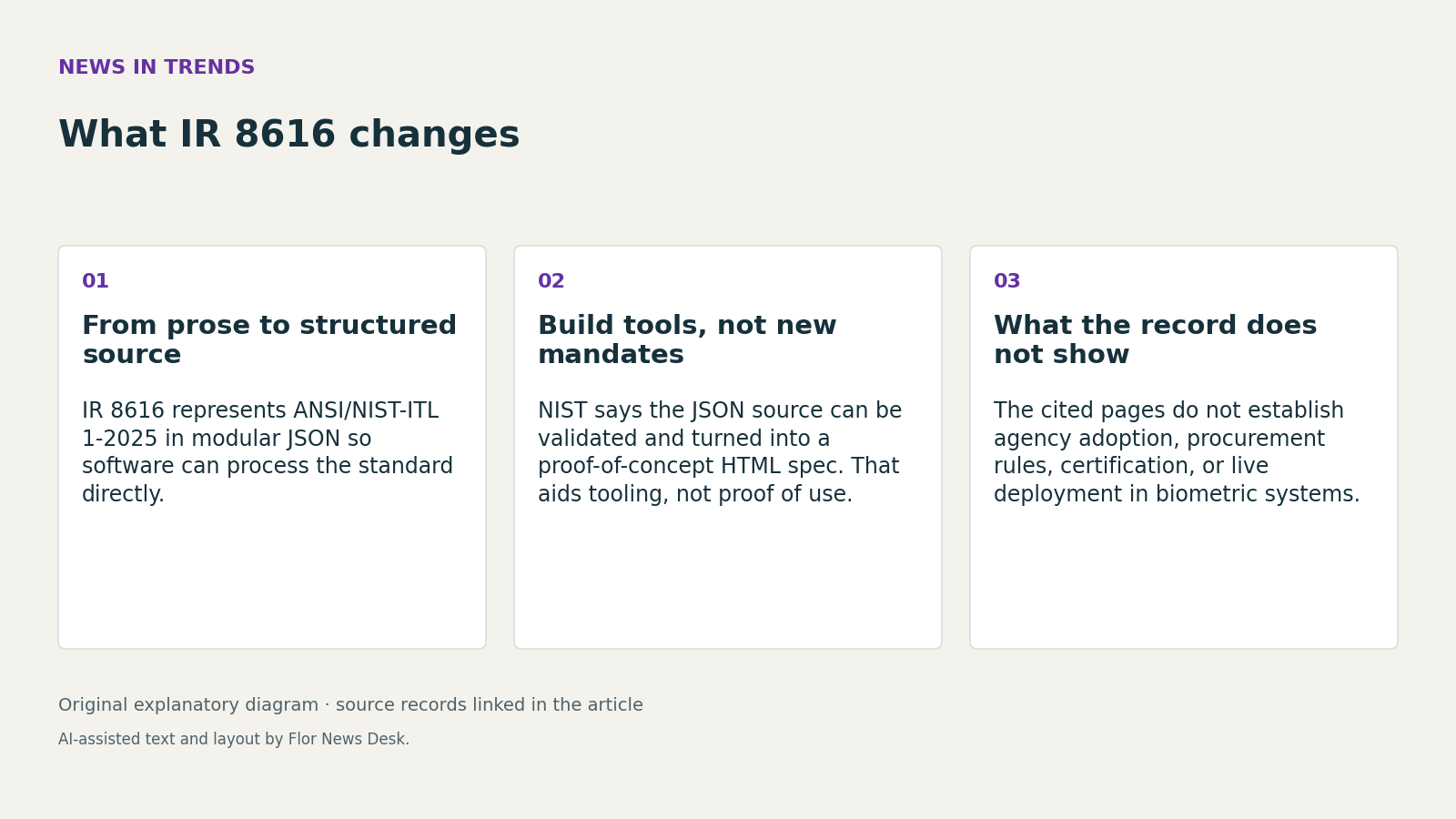
On 16 November 2026, NIST published Internal Report 8616, a machine-readable companion to ANSI/NIST-ITL 1-2025. According to NIST, the report expresses the biometric and forensic data-exchange standard in a modular JSON architecture and uses an automated build process to manage, validate and transform that data into a proof-of-concept HTML specification. That is a concrete change in the tools around the standard, not a new biometric program by itself. NIST announcement NIST publication page
What changed is the form of the standard. The underlying requirements already existed in ANSI/NIST-ITL 1-2025; IR 8616 turns those requirements into structured source that software can read directly, rather than leaving implementers to recode prose and tables by hand. As analysis, that matters because a shared machine-readable source can be reused across validators, import and export libraries, test fixtures and documentation builds, which can narrow avoidable differences between one team’s interpretation and another’s. NIST’s publication page specifically frames the companion as material for developers, testers and auditors. NIST publication page
The timing matters because the base standard is still in an active transition phase. NIST’s ANSI/NIST-ITL 1-2025 page says the 2025 revision was unanimously approved on 15 January 2026, and it also lists sunset dates that leave older encodings in place for years: Traditional Encoding through 31 December 2035, NIEM 2 XML through 31 December 2030, and NIEM 4 XML/JSON through 31 December 2035. That points to coexistence and migration work, not a one-day switch, which helps explain why machine-readable tooling would matter now. ANSI/NIST-ITL 1-2025 page
Still, the public record here is narrower than the headline may sound. NIST’s 16 November 2026 announcement says IR 8616 is intended to lower adoption barriers and reduce interpretation gaps for developers and system integrators, but that is a statement of design intent, not a measured interoperability outcome. The cited NIST pages do not show any agency mandating the JSON companion, any vendor shipping support, any procurement language changing, or any certification program being revised because of IR 8616. NIST announcement NIST publication page
There is also a versioning question that the available pages do not settle. The NIST standards page still contains a 1 July 2026 notice about a 30-day review of a draft NIEM 4 XML encoding package, with comments due 1 August 2026, and it describes addendum work as "February 2026 - current." As of 18 November 2026, those passages are historical notices, not proof of completion or present status. The page shows that encoding work was active, but it does not establish which related packages were finalized or how later corrections map onto the new machine-readable companion. ANSI/NIST-ITL 1-2025 page
So IR 8616 looks less like a policy turning point than an infrastructure move. If later conformance programs, procurement documents or open-source toolchains begin to reference this machine-readable specification, 16 November 2026 may look like the date the standard became easier to implement consistently. For now, the evidence supports a tighter claim: NIST has published a maintained technical companion that could improve standard-handling workflows, while leaving adoption, oversight and real-world use unproven in the cited record. NIST announcement NIST publication page
Read our editorial standards or send a correction to the editorial desk.