

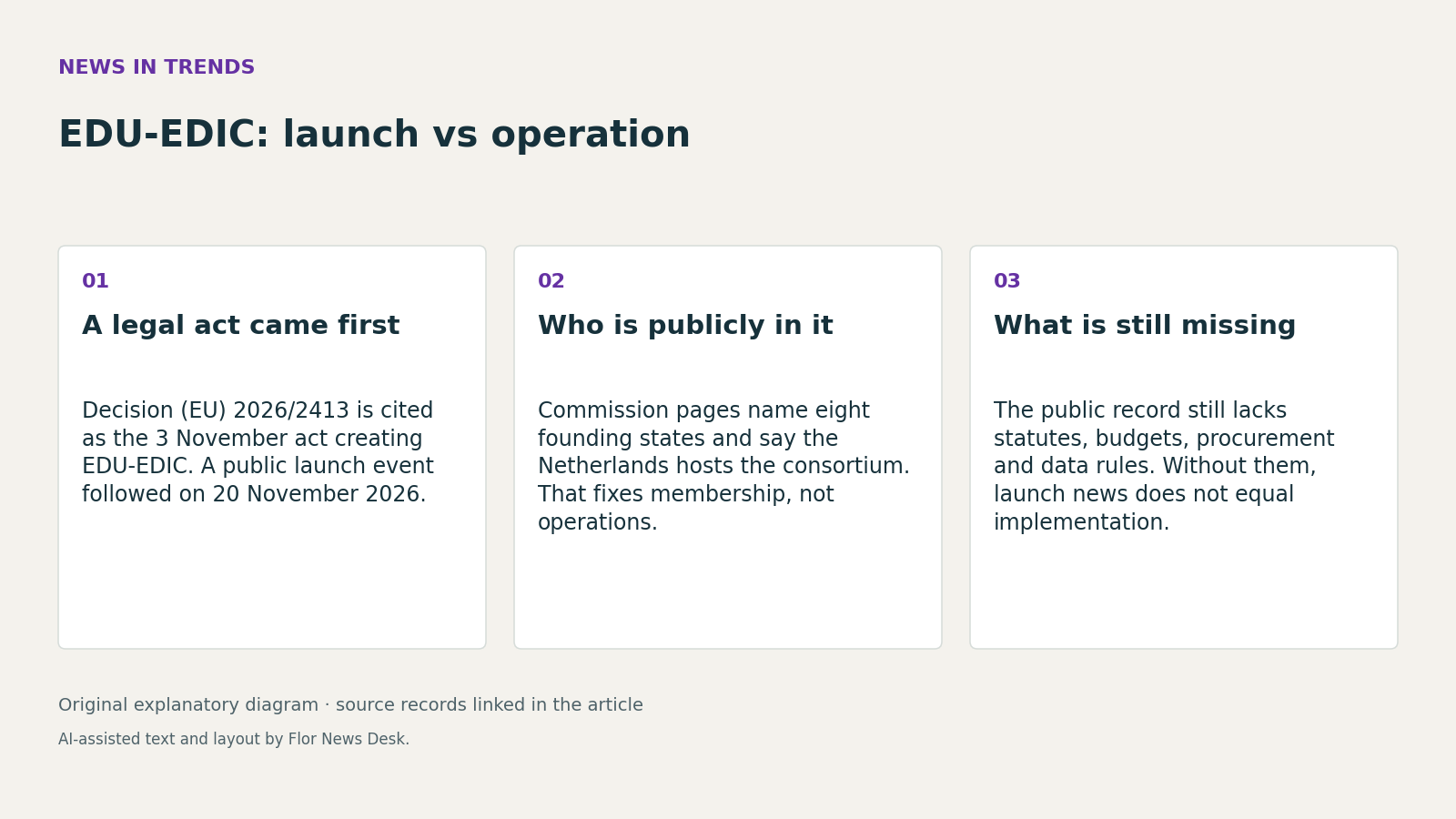
On 20 November 2026, the European Commission and eight Member States publicly launched the European Digital Infrastructure Consortium on Education, or EDU-EDIC Commission news event page. That is a concrete institutional change: not just a policy slogan, but a named cross-border body. It is also a narrower change than the launch branding can imply. The public Commission record shows that a legal vehicle now exists for joint digital education projects. It does not yet show what schools can buy through it, what vendors can bid for, or how student data would be governed.
The legal step came earlier. The Commission’s EDIC overview says an EDIC is a legal framework under the Digital Decade Policy Programme 2030, and that each EDIC becomes a legal person through a Commission decision after an application from at least three Member States EDIC policy page. The same page identifies Commission Implementing Decision (EU) 2026/2413 of 3 November 2026 as the act that set up EDU-EDIC EDIC policy page. The 20 November event therefore matters as a political launch, not as evidence that services, contracts or classroom tools were already in place.
Membership is the clearest public fact. The Commission names Belgium, Croatia, Finland, France, Greece, Slovenia, Spain and the Netherlands as participating states, and says the Netherlands will host the consortium Commission news. The launch event page adds a short Berlaymont programme and lists Henna Virkkunen, Roxana Mînzatu and Judith Tielen as speakers event page. But that page is still an agenda-style record. Retrieved on 21 November 2026, its future-tense wording preserves what the Commission planned to present, not a full operating status report event page.
What the consortium is for is also public, at a high level. The Commission says EDU-EDIC is meant to pool resources and expertise for shared and interoperable digital education infrastructure, and its EDIC overview says the consortium should help reduce reliance on non-EU providers Commission news EDIC policy page. The analysis question is what follows from that. If member states later buy or build common systems through EDU-EDIC, the body could matter in vendor negotiations and technical standard-setting across several countries at once. The current record does not establish that any such procurement, hosting rule or deployment has begun.
That missing layer is not a minor footnote. The Commission’s EDIC page says founding states set governance and other operating rules in the statutes, and that EDIC budgets rest on members’ contributions, with the possibility of other revenue including EU and national grants EDIC policy page. Yet the public pages in this record do not publish EDU-EDIC’s statutes, member contributions, voting arrangements, procurement procedures, data-location terms, GDPR compliance setup or delivery timetable Commission news EDIC policy page. Those omissions mean readers should separate announced purpose from implementation, and announced funding possibilities from money actually received.
For schools, ministries and EdTech companies, the practical takeaway on 21 November 2026 is restrained. Commission records show EDU-EDIC exists as a legal and political forum, with identified founding governments and a launch date Commission news EDIC policy page. They do not yet show an open market, a published technical architecture or a settled data-governance regime. The next meaningful documents are not more launch speeches. They are the statutes, any procurement notices and any detailed operational rules that show how this EU sovereignty project would work in practice.
Read our editorial standards or send a correction to the editorial desk.