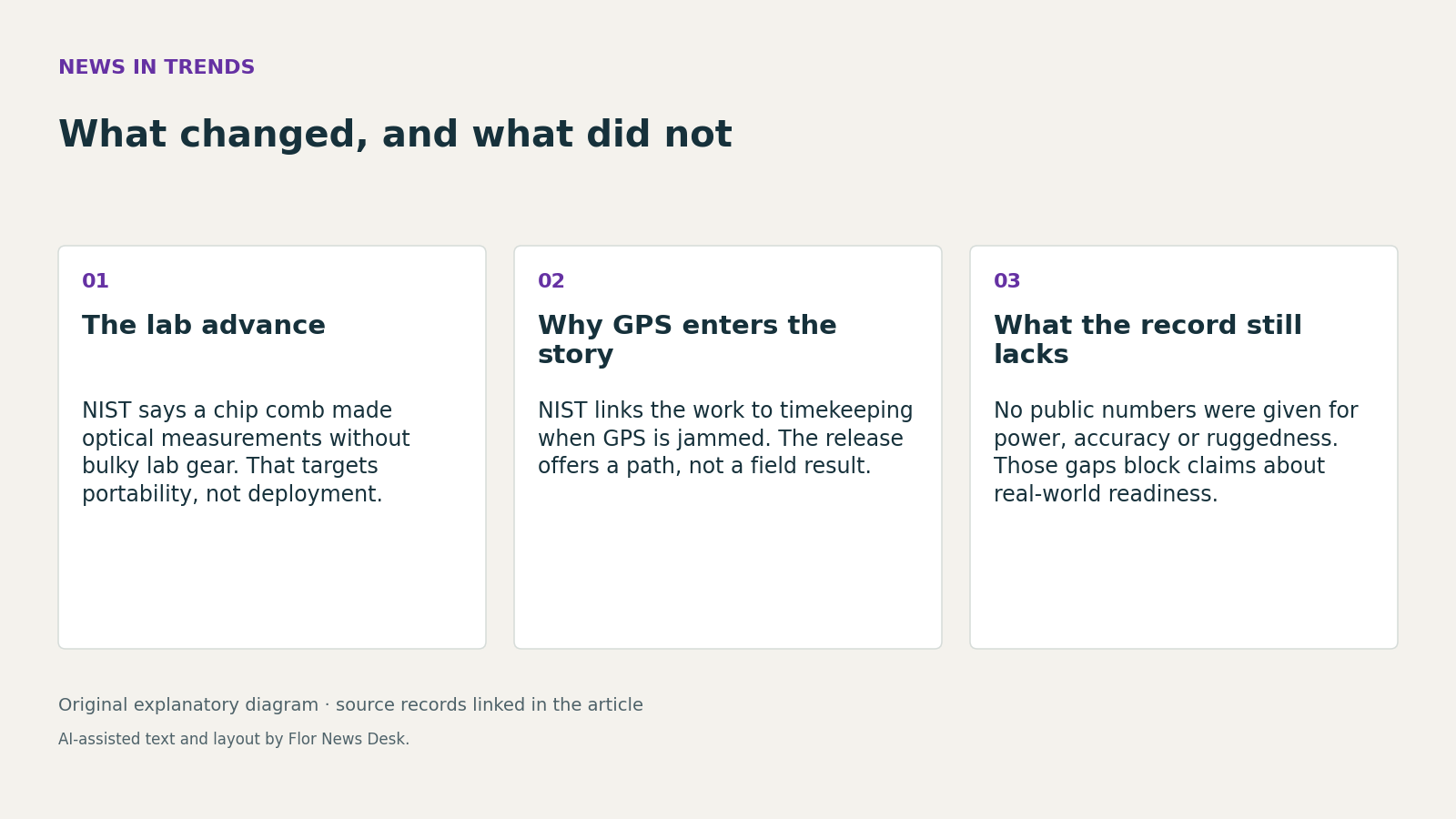
On October 16, 2026, NIST said its researchers and collaborators had demonstrated a microchip frequency comb that can make optical measurements without being tethered to bulky laboratory equipment, and NIST described frequency combs as essential components of optical atomic clocks. That is a meaningful change in the lab record because it targets a support system around the clock, not a vague future use case. NIST release, October 16, 2026
The engineering point matters. According to NIST, the device is produced by sending light from two lasers around a microresonator. NIST says that two-laser design avoids the stability problems of earlier single-laser approaches, which needed extra power-hungry equipment. Read narrowly, that means one barrier to portability may be shrinking: not the need for precise optical measurement itself, but the amount of external hardware required to keep that measurement stable. NIST release, October 16, 2026
That is also why the GPS angle should be read carefully. NIST presents the result as a possible path toward mobile optical timekeeping and navigation signals when GPS is unavailable or jammed. The source supports the possibility, not the outcome. A chip comb that no longer depends on bulky bench equipment could make an optical clock easier to package into a mobile system. But the October 16 record does not report a vehicle test, a timing holdover trial, or a navigation result under jamming. It is evidence of a lab step toward portability, not evidence that a deployable GPS backup now exists. NIST release, October 16, 2026
The missing details are not minor. NIST’s release does not give clock accuracy, power draw, lifetime, environmental tolerance, or readiness level, and the page does not identify a journal paper or independent verification details in the briefed record. Those omissions matter because the public case for resilient timing lives or dies on system performance outside a controlled setup. Without those numbers, the announcement cannot establish whether the chip changes procurement timelines, certification prospects, or operational suitability. NIST release, October 16, 2026
A second NIST release from September 10, 2026 helps define the limit. In that separate project, NIST said its transition edge sensors improved X-ray measurements for nuclear monitoring, but it also said the cooling equipment remained too bulky to be handheld, even if arrays can operate where electrical power is available. The contrast is useful: NIST’s October comb result is a real miniaturization claim in timekeeping hardware, yet nearby quantum-adjacent systems in NIST’s own portfolio still show how fast laboratory performance can run ahead of fieldable packaging. NIST release, September 10, 2026
There is one more clue, and it is only a clue. An image caption on the October page says each wafer contains more than 400 chips, with up to 300 ring-shaped resonators per chip. That suggests a platform being pursued at scale rather than a single custom optical assembly. It does not, however, show manufacturing yield, cost, or reliability. The next decisive record would be a full optical clock prototype with published power and environmental data, followed by a real navigation or timing-holdover demonstration. Until then, the strongest conclusion is narrower and still important: NIST appears to have reduced one of the bulky pieces that kept optical clocks tied to the lab. NIST release, October 16, 2026
Read our editorial standards or send a correction to the editorial desk.