A new 2026 handbook from the International Telecommunication Union turns a familiar warning about weather infrastructure into something more usable in spectrum disputes: a technical reference. ITU’s publication page for *Use of radio spectrum for meteorology: weather, climate, water and related environmental applications* says the handbook covers the World Meteorological Organization’s observing infrastructure, the radio-frequency bands used by key systems, criteria for harmful interference, and the effects that interference can have on data, forecasts and early warning services (ITU handbook page).
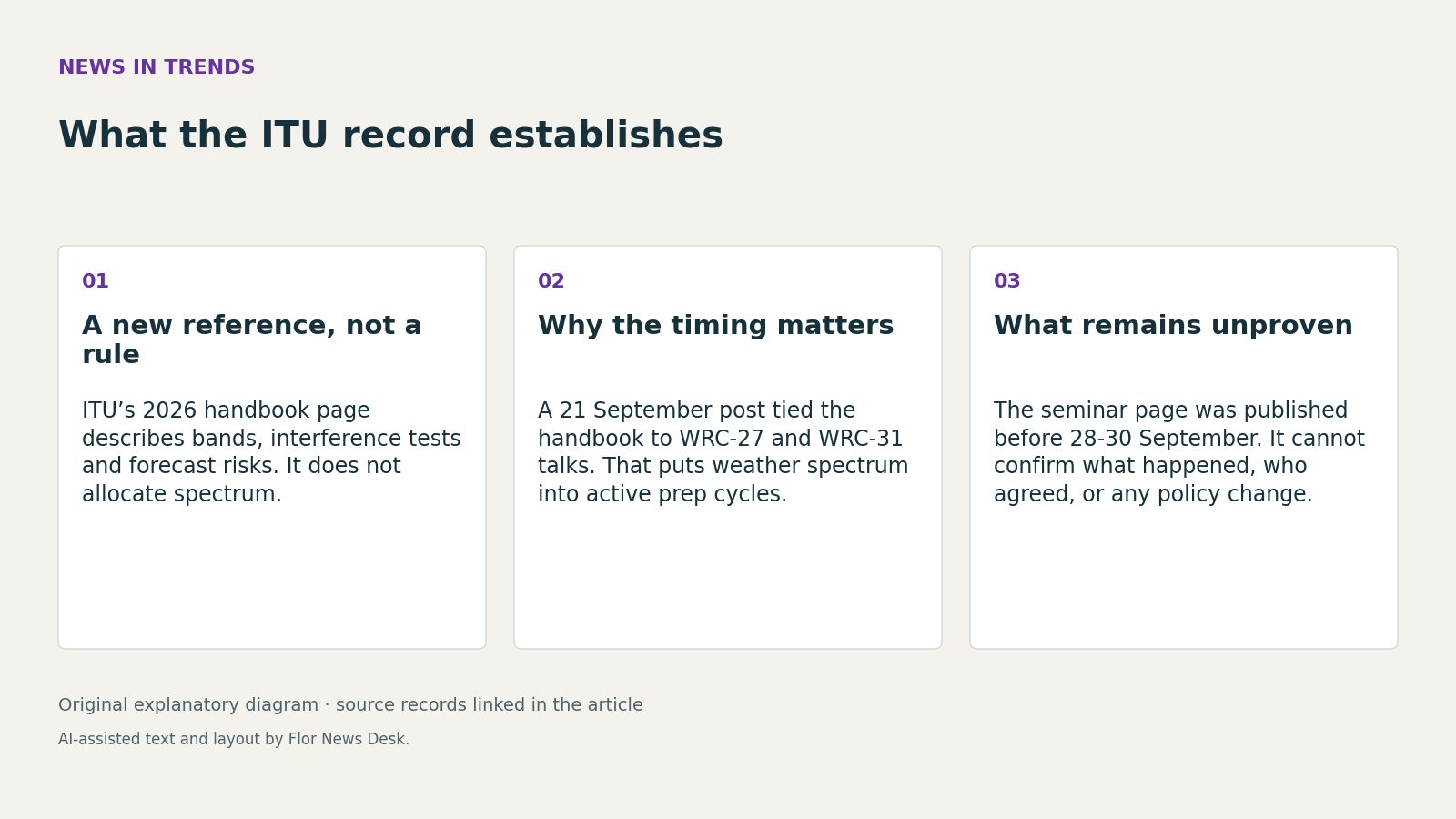
That matters because it changes the form of the argument, even if it does not change the law. In analytical terms, a plea to “protect weather spectrum” is easier for regulators or industry groups to sidestep than a document that organizes which systems use which bands, how interference should be assessed, and what operations are at risk. ITU also says the handbook may serve as a reference for professional users, policymakers, regulators and the radiocommunications community (ITU handbook page). The strongest documented development here is therefore not a new allocation. It is the arrival of a common technical text that can be cited in consultations and conference preparation.
A second ITU record shows how the agency wants that text used. In a news post published on 21 September 2026, ITU argued that interference-free spectrum is essential for meteorological services and Earth observation, including passive sensors that detect naturally emitted radio-frequency energy (ITU news post, 21 September 2026). The same post said a Global ITU/WMO Seminar was scheduled for 28 to 30 September 2026 in Geneva, with planned discussions on regulatory and interference challenges, commercial environmental data, cloud-based processing, and preparations for the World Radiocommunication Conferences in 2027 and 2031 (ITU news post, 21 September 2026).
Taken together, those two pages point to a broader shift in emphasis. This is no longer framed only as a technical concern for weather agencies. ITU’s own agenda connected meteorological spectrum to commercial data markets, processing infrastructure and the long lead-up to WRC-27 and WRC-31 (ITU news post, 21 September 2026). As analysis, that suggests the handbook is meant to function as a negotiating tool in a more crowded communications environment, where weather sensing has to defend itself not just on public-interest grounds but with detailed engineering criteria.
Just as important is what the record does not establish. The handbook page gives only the publication year 2026, not a full publication date, and it does not show any national or international regulatory change or any measured operational effect (ITU handbook page). The 21 September post was published before the seminar it described. Its future-tense statements about what “would” happen on 28 to 30 September are, by 6 October 2026, historical expectations rather than proof that the seminar, signing or launch occurred as planned (ITU news post, 21 September 2026).
So the practical takeaway is narrower than a victory lap. ITU has added a 2026 handbook that consolidates the technical case for protecting spectrum used by weather, climate, water and related environmental applications, and it has publicly tied that case to upcoming radiocommunication conference work (ITU handbook page; ITU news post, 21 September 2026). What readers should watch next are later national consultations or conference-preparatory records that cite the handbook’s band lists or interference criteria. Those would show the document moving from reference shelf to policy leverage. The sources here do not yet show that outcome.
Read our editorial standards or send a correction to the editorial desk.