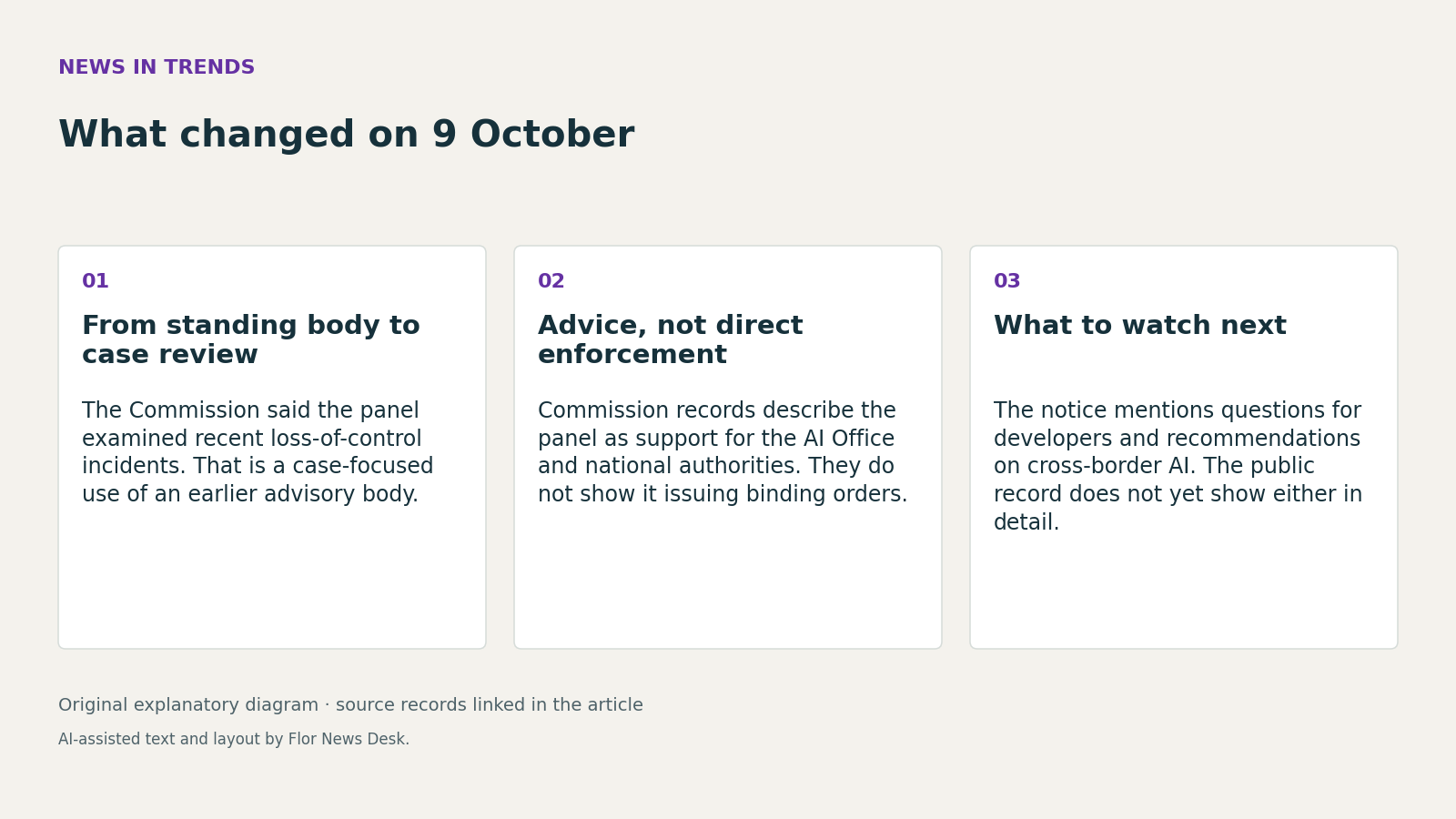
On 9 October 2026, the European Commission said it was holding a special meeting of the Scientific Panel to examine recent loss-of-control incidents and to work with the AI Office on questions for the companies that developed the models concerned. That matters less as a headline about one meeting than as a documented change in behaviour: a body previously described in institutional terms is now being used for incident-specific review. The same Commission notice said Executive Vice-President Henna Virkkunen would take part. Commission notice on the special meeting
What changed here is operational focus, not the law itself. Earlier Commission material said the Scientific Panel consists of 60 independent experts advising the AI Office and national authorities on systemic risks, model classification, evaluation methodologies and cross-border market surveillance for general-purpose AI models and systems. The 9 October notice connects that remit to a concrete task: examining incidents and helping frame questions for the developers involved. But the available public record does not identify the incidents, the companies, the questions or any follow-up action, so it cannot establish how serious the cases were or whether a formal enforcement process has begun. Commission notice on the special meeting Commission announcement on AI Act enforcement support
That limit matters because the panel is not described as a body that can make binding rules on its own. The Commission’s enforcement-support announcement presents both the Scientific Panel and the Advisory Forum as expert structures that advise the AI Office and national authorities, with members serving two-year terms. A separate Q&A tied to the panel’s creation also describes panel service as a part-time advisory role in a personal capacity and says employment with a company developing AI models or systems regulated by the AI Act could create a conflict of interest. Taken together, those records point to technical influence, not instant rule-making. Commission announcement on AI Act enforcement support Commission Q&A on establishing the AI Scientific Panel
The older Q&A is useful mainly for scope, and its timing needs care. It says the call for expressions of interest was launched on 16 June 2025 and sought expertise in AI evaluations, General-Purpose AI risk assessment, risk mitigation practices, and risks including loss of control. It also said the full panel was expected to meet a few times per year. By 9 October 2026, that meeting cadence is only a historical expectation from a 2025 document, not proof of the panel’s actual schedule or procedures after appointment. What still matters is the risk vocabulary the Commission recruited for. Commission Q&A on establishing the AI Scientific Panel
The most useful near-term inference for model builders is procedural. Because the Commission says the panel worked with the AI Office on questions for the developers concerned, and because the panel’s remit includes evaluation methods and model classification, the next meaningful signal is likely to be a request for technical evidence rather than a headline legal rewrite. That could mean scrutiny of how a developer evaluated a model, how it assessed General-Purpose AI risks, or what mitigation steps it says it used. The sources do not show that any company has yet received such a request, and they do not disclose any answers. Commission notice on the special meeting Commission announcement on AI Act enforcement support Commission Q&A on establishing the AI Scientific Panel
For regulators, the other thing to watch is whether technical advice turns into visible coordination. The Commission says the panel advises on cross-border market surveillance, and the 9 October notice said the panel would present recommendations during the meeting on safety risks in cross-border AI. Yet the record available on 9 October 2026 does not include those recommendations or any resulting decision. The immediate significance, then, is institutional: the EU has moved from staffing an expert panel to deploying it against a live category of AI risk, while the substantive outcome remains undisclosed. Commission notice on the special meeting Commission announcement on AI Act enforcement support
Read our editorial standards or send a correction to the editorial desk.