

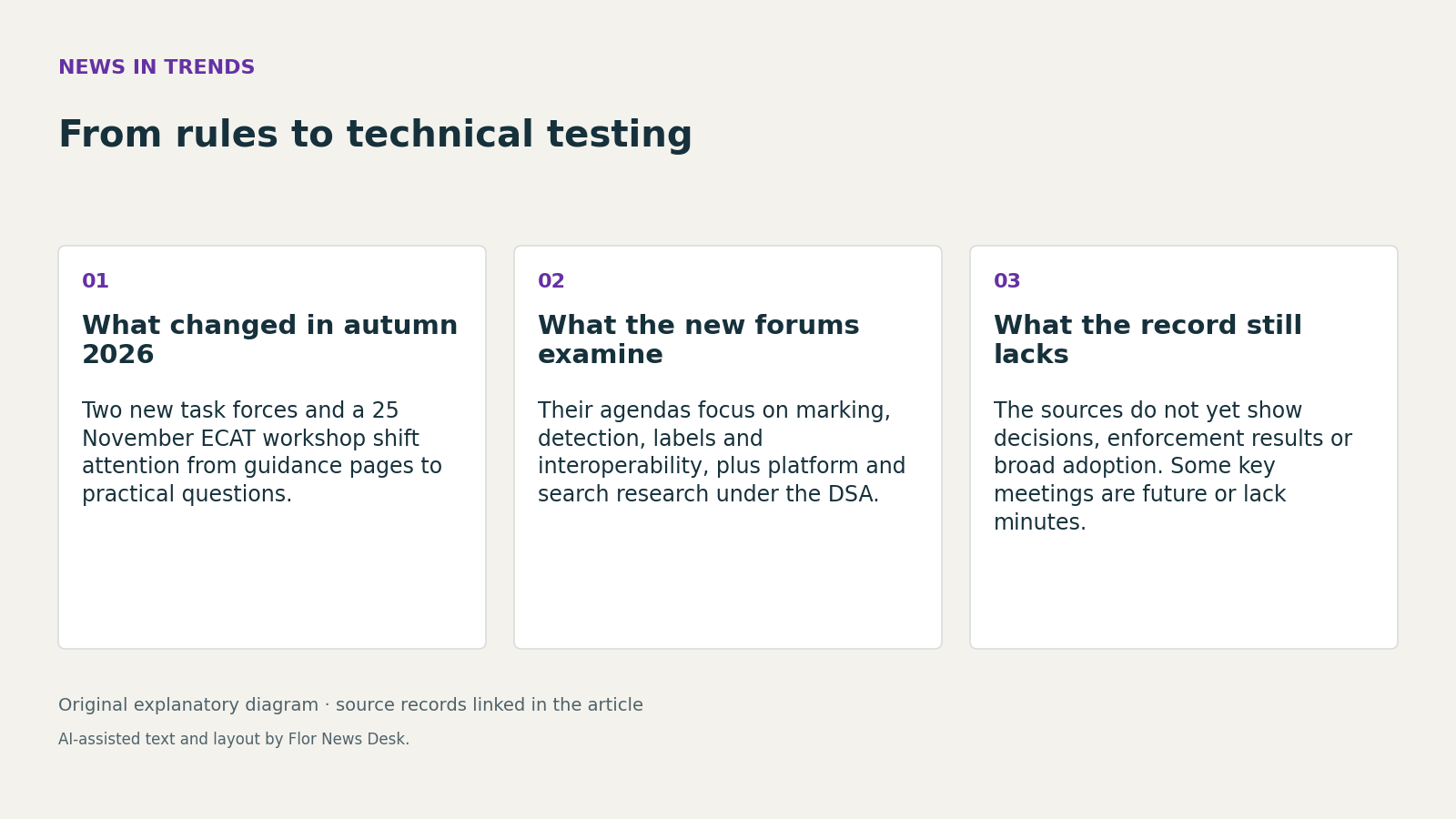
On 30 September 2026, more than 90 signatories created two task forces under the Code of Practice on Transparency of AI-generated Content, and on 25 November 2026 the European Centre for Algorithmic Transparency will host a one-day research workshop on generative AI, platforms and search engines. Taken together, those dates suggest a change in method: after summer 2026 notices about transparency guidance and enforcement, EU bodies are now convening researchers and signatories around practical questions such as detection, labelling and interoperability. Commission task forces page ECAT workshop page AI Alliance news index
That shift matters because ECAT is tied to the Digital Services Act’s research and oversight machinery, not just event programming. Its homepage says ECAT provides scientific and technical expertise for the European Commission’s supervisory and enforcement role on DSA systemic obligations for designated Very Large Online Platforms and Very Large Online Search Engines. The 25 November 2026 event is listed as ECAT’s third annual research workshop, mainly for researchers and already full with a waiting list. Its planned sessions cover generative AI on social media, vulnerable audiences, LLM-based search, harmful manipulation and information integrity, with speakers from the Joint Research Centre, the AI Office, universities and civil-society organisations. ECAT homepage ECAT workshop page
The workshop matters less as a verdict than as a framing device. It turns broad transparency politics into research questions that can be tested or disputed: how AI search changes information retrieval, how manipulation should be evaluated, and how vulnerable audiences fit into platform risk analysis. One listed talk description also places the discussion in the context of ChatGPT’s recent DSA designation as a very large online search engine. But as of 15 November 2026, the workshop has not taken place. The source record supports only the planned agenda, participants and institutional framing, not findings, enforcement action or technical consensus. ECAT workshop page
The signatory task forces are closer to implementation, but they are still early-stage coordination. The Commission page says Task Force 1 covers Marking & Detection, including interoperability, provider-neutral approaches, possible interface standardisation, benchmarks or best practices, and red-teaming of current methods. Its Interoperability working group is meant to help ordinary users assess whether content is AI-generated or manipulated without trying several detectors separately. The same page says an interoperability meeting was held on 23 October 2026 and listed 5 November 2026 as the next meeting. Because 5 November is already past and minutes were still pending in the retrieved record, the sources do not establish what, if anything, was settled. Commission task forces page
Task Force 2 asks a different question: what should disclosure look like when users actually encounter it? The Commission page says it covers the EU icon, an interactive second layer, methods for disclosing AI involvement and sectoral practices, with January 2027 launches planned for working groups on the Interactive Second Layer and an EU Audio Earcon. The analytical point is that these are design and coordination problems, not evidence of adoption. A detector can exist without interoperating. A label can be proposed without becoming legible across services. The retrieved page shows that signatories are trying to narrow those gaps, but it does not show that common standards are already in use. Commission task forces page
The rest of the source record sharpens that limit. A Commission AI policy news index includes entries dated 23 July 2026 for an AI transparency package and 3 August 2026 for the start of new transparency requirements, which helps date the earlier policy phase, but the retrieved page is only an index and does not establish the full legal scope or measured effects. A separate Knowledge4Policy search-results page retrieved for this assignment showed mostly unrelated items from 10 to 13 November 2026, not a dedicated update on these transparency efforts. For now, the strongest documented story is procedural: Brussels is moving from announcing transparency rules to staging technical forums that could either align practice or expose disagreement. What readers should watch next is concrete output: published minutes, benchmark proposals and any post-workshop documents that turn agendas into testable standards. AI Alliance news index Knowledge4Policy search page
Read our editorial standards or send a correction to the editorial desk.