

Since 2 August 2026, at least on paper, the EU has treated AI transparency less like a general principle and more like a product requirement. The Commission’s guidance on Article 50 says providers of AI systems for direct interaction must explicitly inform people they are dealing with AI, while providers of systems generating synthetic audio, images, video or text must make outputs detectable in machine-readable form Commission guidance Article 50 summary. That matters because it shifts the debate from whether disclosure is good to where, when and in what format it has to appear.
The timing requirement is the most practical change. The service-desk summary says information should be clear, distinguishable and accessible by the first interaction or first exposure, unless the AI use is obvious to a reasonably well-informed person in context or a specific exception applies Article 50 summary. The broader guidance page extends that logic to deployers: people exposed to emotion recognition, biometric categorisation, deepfakes, or certain public-interest text without human review or editorial control must be informed Commission guidance. In plain terms, a buried footer is not the model the EU documents describe.
Marking and labelling are also separated more carefully than many policy debates suggest. The Article 50 summary focuses on machine-readable marks, added as far as technically feasible, so synthetic content can be detected by systems as well as by people Article 50 summary. A Commission news page last updated 12 June 2026 presented a voluntary Code of Practice meant to help providers and deployers meet those transparency duties, including labels for deepfakes, AI-manipulated public-interest text and interactive systems such as chatbots Code of Practice page. The gap is important: the legal obligation and the voluntary playbook are not the same thing, and that page does not establish adoption or accuracy rates.
The model-level disclosure tool is different again. A Commission FAQ says providers that place general-purpose AI models on the Union market must publish a public Summary of Training Content, using a mandatory template under Article 53(1)(d) Training-content template FAQ. According to that page, the obligation applies from 2 August 2025, providers of models already on the market before that date should publish by 2 August 2027, and summaries must appear on the provider’s official website and alongside the model on public distribution channels Training-content template FAQ. That is not a full audit of training data. It is a baseline record meant to create a public trace that buyers, regulators and critics can inspect.
These pages also show where transparency stops short of a complete privacy answer. The guidance page divides enforcement among national market surveillance authorities, the AI Office for systems under its supervision, and the European Data Protection Supervisor when EU institutions are the provider or deployer Commission guidance. The service-desk page separately says deployers of emotion recognition and biometric categorisation systems must process personal data in line with EU data-protection law Article 50 summary. The implication is structural: AI Act notices and labels sit beside privacy law, not above it. The cited records do not establish a user-facing opt-out from model training or a proven route to erase memorised personal data from model behaviour.
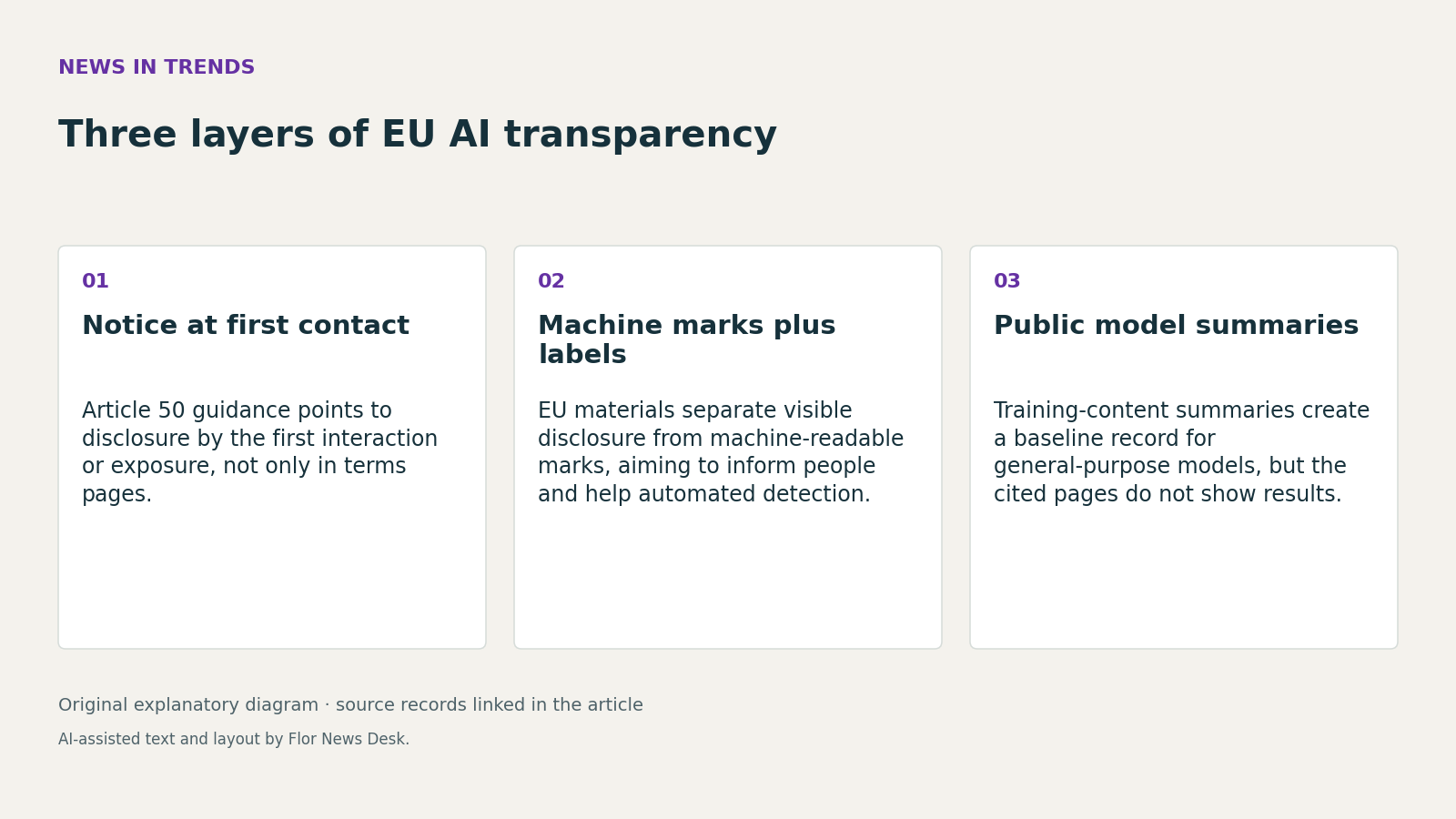
As of 4 November 2026, the useful lesson from these EU materials is narrower and more concrete than the usual AI-governance rhetoric. They describe three operational tests: tell people at the first meaningful moment, mark synthetic outputs so machines can help detect them, and publish a standard training-content summary for general-purpose models Commission guidance Article 50 summary Code of Practice page Training-content template FAQ. What they do not yet show is the harder part of regulation: who complied, what was enforced, and whether the disclosures changed how people and institutions actually use AI.
Read our editorial standards or send a correction to the editorial desk.