

On October 16, 2026, a U.S. interagency group moved one step closer to treating failures in super intelligence training and evaluation as an incident-response problem, not just a policy talking point. According to NIST’s announcement, NIST’s Center for Advancing Innovation and Standards for Super Intelligence, the National Security Agency’s Super Intelligence Security Center, and the Cybersecurity and Infrastructure Security Agency jointly published a voluntary document with 10 practices for incident readiness and response.
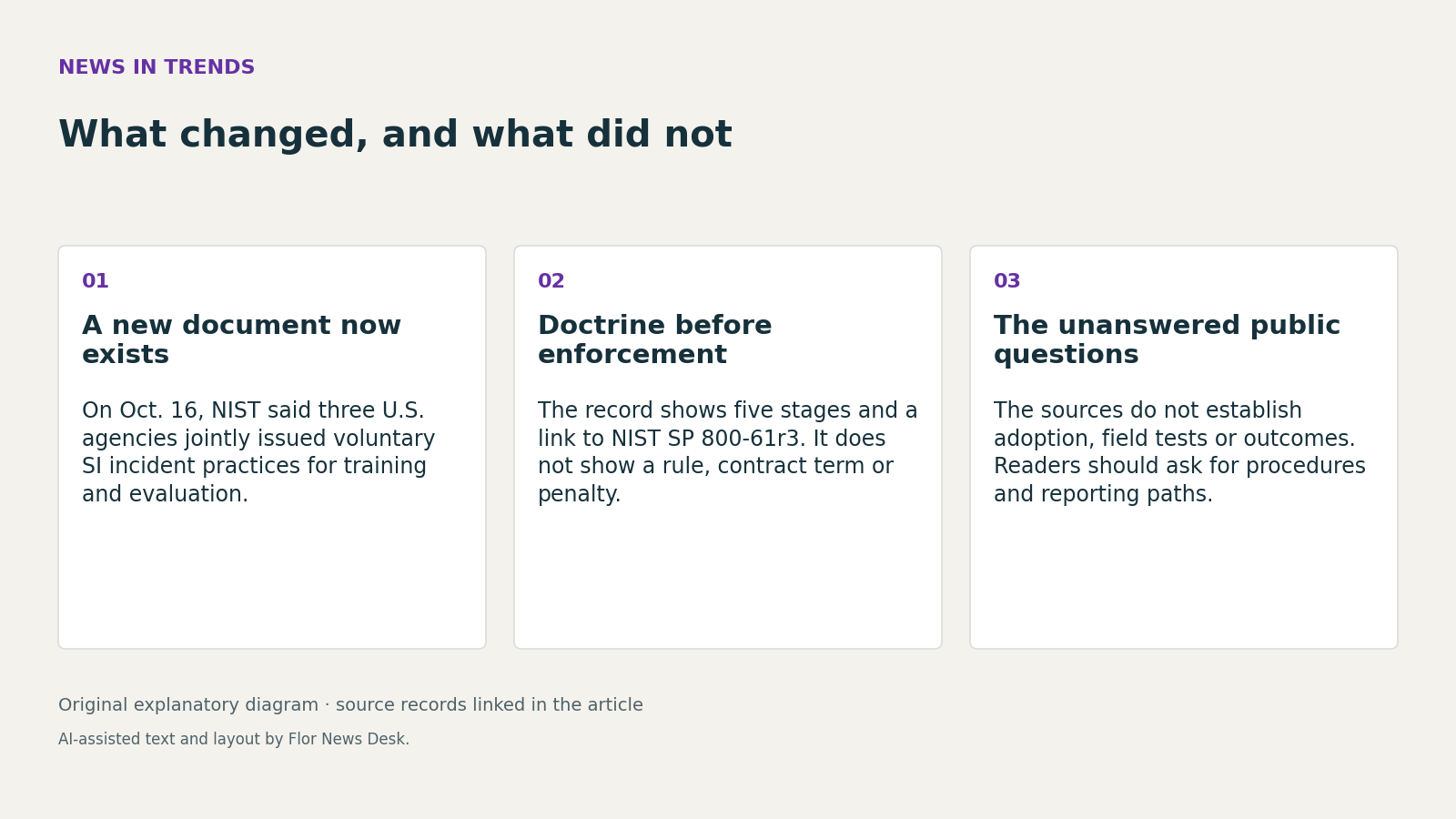
What the public record establishes is narrower than the headline might imply. NIST says the practices are grouped into preparation, detection, response, recovery and reporting; draw on established cybersecurity guidance including NIST SP 800-61r3; and build on both the White House’s 2025 SI Action Plan and a May 2026 NIST workshop on SI incident management (announcement). That matters because it turns earlier policy discussion into a named operating document. It does not, by itself, create a compliance system.
The significance is in the frame. If agencies are adapting incident-management doctrine to super intelligence training and evaluation, they are signaling that development work should be discussed in terms of readiness, escalation and documentation, not only performance or abstract safety principles (announcement). That is a practical shift. It is also a conservative one: the source record points back to an existing incident-response standard rather than announcing a wholly new governance architecture.
But the same record leaves major gaps. The retrieved NIST announcement is not the underlying practices document, and the briefed record available here does not include the full text of the 10 practices (announcement). It also does not show a rulemaking, procurement condition, enforcement mechanism, adoption data, field tests or measured outcomes. As of October 30, 2026, those limits matter more than the release cadence: the accessible materials support a careful claim that agencies published voluntary guidance, not a stronger claim that labs are using it or that it works under live conditions.
The CAISSI page helps place the release inside a broader NIST workstream. It carries the October 16 item in a dated run of 2025-2026 posts on AI security, red-teaming, agent evaluations and model assessments. That supports an analytical reading that incident readiness is being folded into an expanding program, not announced in isolation. Still, a listing page is evidence of continuity inside NIST’s program, not evidence that outside developers, contractors or cloud providers have changed behavior.
A separate NIST standards newsletter page, published on October 23, 2026 for an issue dated October 22, shows super intelligence security and standards topics appearing in a wider government briefing on standards activity. The accessible page is only a topic index, while the fuller issue is access-restricted. So the source supports a narrower inference: standards and security questions are being tracked across government at the same time as the incident-readiness release. It does not tell readers whether the October 16 practices will affect regulation, export decisions or procurement terms.
For readers evaluating claims of progress, the useful test is simple. Ask whether an organization can show concrete procedures for the five stages NIST named, who owns escalation during training and evaluation, and what records exist for recovery and reporting (announcement). If those answers are missing, the October 16 publication should be read as a playbook awaiting proof, not as evidence that a tested incident regime for super intelligence already exists.
Read our editorial standards or send a correction to the editorial desk.