On 5 October 2026, UNESCO put a hard number on a problem that is often left vague: the world has 107 million teachers and needs 50 million more by 2030 to reach universal pre-primary, primary and secondary education. UNESCO also said 58% of that need is not for brand-new expansion but for replacing teachers who leave the profession. That distinction matters because it changes the policy question from simply how to staff more classrooms to how to stop existing classrooms from losing staff in the first place. UNESCO teacher article
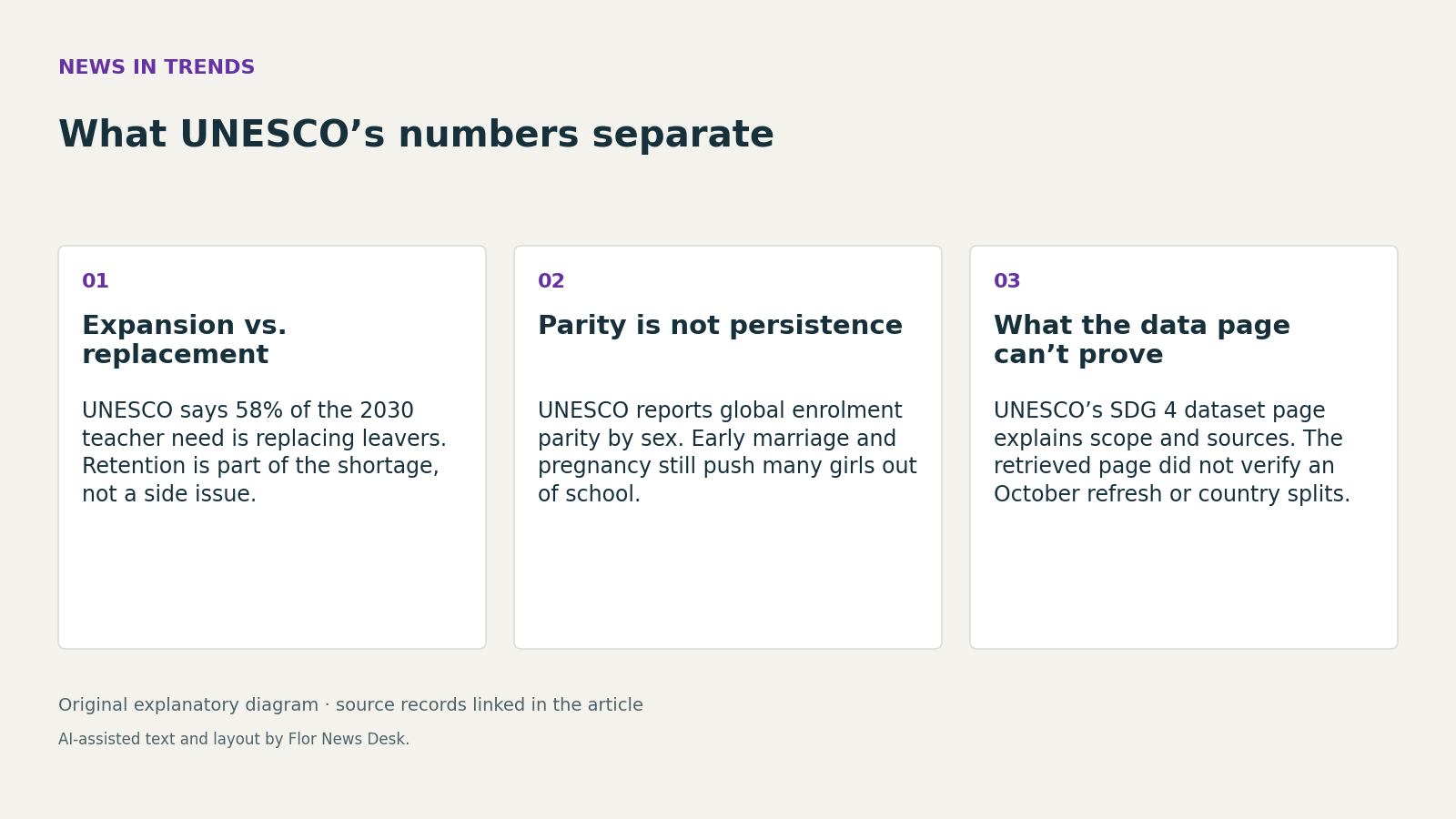
The replacement share is the most consequential part of the figure. A headline about a teacher shortage can imply a pipeline problem: train more people, hire more people, and the gap narrows. UNESCO’s breakdown suggests a retention problem is carrying much of the weight. The same UNESCO article says that in 75% of countries participating in OECD TALIS 2024, fewer than 40% of teachers felt the profession was valued, and that teachers spend about 19 hours a week in the classroom but around 60 hours a week working in total. Those are not proof of a single global cause, but they do show why a larger teacher count alone may not settle the issue. UNESCO teacher article
That is also why the number should complicate many technology pitches. A quantified labour gap can look like a market for substitution. UNESCO’s own figures point in a narrower direction: if more than half the need comes from replacing leavers, then software, tutoring platforms or AI classroom tools address only part of the problem unless they are tied to teacher workload, training or retention. The UNESCO article also notes that UNESCO and the International Labour Organization have launched a joint revision of the 1966 ILO/UNESCO Recommendation concerning the Status of Teachers, with work guided through mid-2027. That is a policy process, not evidence of improvement yet. UNESCO teacher article
The broader access picture makes the staffing figure harder, not easier, to wave away. A 7 September 2026 summary of the 2026 GEM Report says 273 million children and youth are out of school worldwide, the seventh consecutive annual rise, even after primary and secondary education added 327 million students since 2000. The same summary says fewer than 1 in 10 countries have a strong equity orientation in their education finance mechanisms. Put together, those figures suggest the teacher gap sits inside a larger access-and-finance problem, not outside it. GEM summary
UNESCO’s 8 October 2026 gender release adds a second warning about what aggregate progress can hide. UNESCO says gender parity in enrolment has been achieved globally from pre-primary through upper secondary education. But the same release says child marriage still affects 25% of girls in Central and Southern Asia and 31% in sub-Saharan Africa, that 6 million pregnant and young mothers aged 10–19 were out of school in sub-Saharan Africa in 2024, and that fewer than 5% of pregnant and parenting girls there return to school. So parity in enrolment is not the same thing as secure continuation in education. UNESCO gender release
The source record also sets clear limits. UNESCO’s public SDG 4 dataset page describes a globally comparable indicator system built from administrative data, household surveys, learning assessments and partner sources across more than 200 countries. But, as retrieved on 20 October 2026, that page did not itself verify a specific October refresh date or provide the teacher-gap values cited elsewhere. It is useful for understanding scope and method, not for proving a fresh release timeline or country-level allocation of the 50 million figure. UIS dataset page
That leaves a more practical reading of UNESCO’s October numbers. They do not tell readers which countries drive the shortfall, what budgets are committed, or which interventions work. They do show that “teacher shortage” is too blunt a phrase. The documented gap is partly about adding teachers, but heavily about keeping them, and the gender data shows why enrolment gains alone can still leave major barriers in place.
Read our editorial standards or send a correction to the editorial desk.