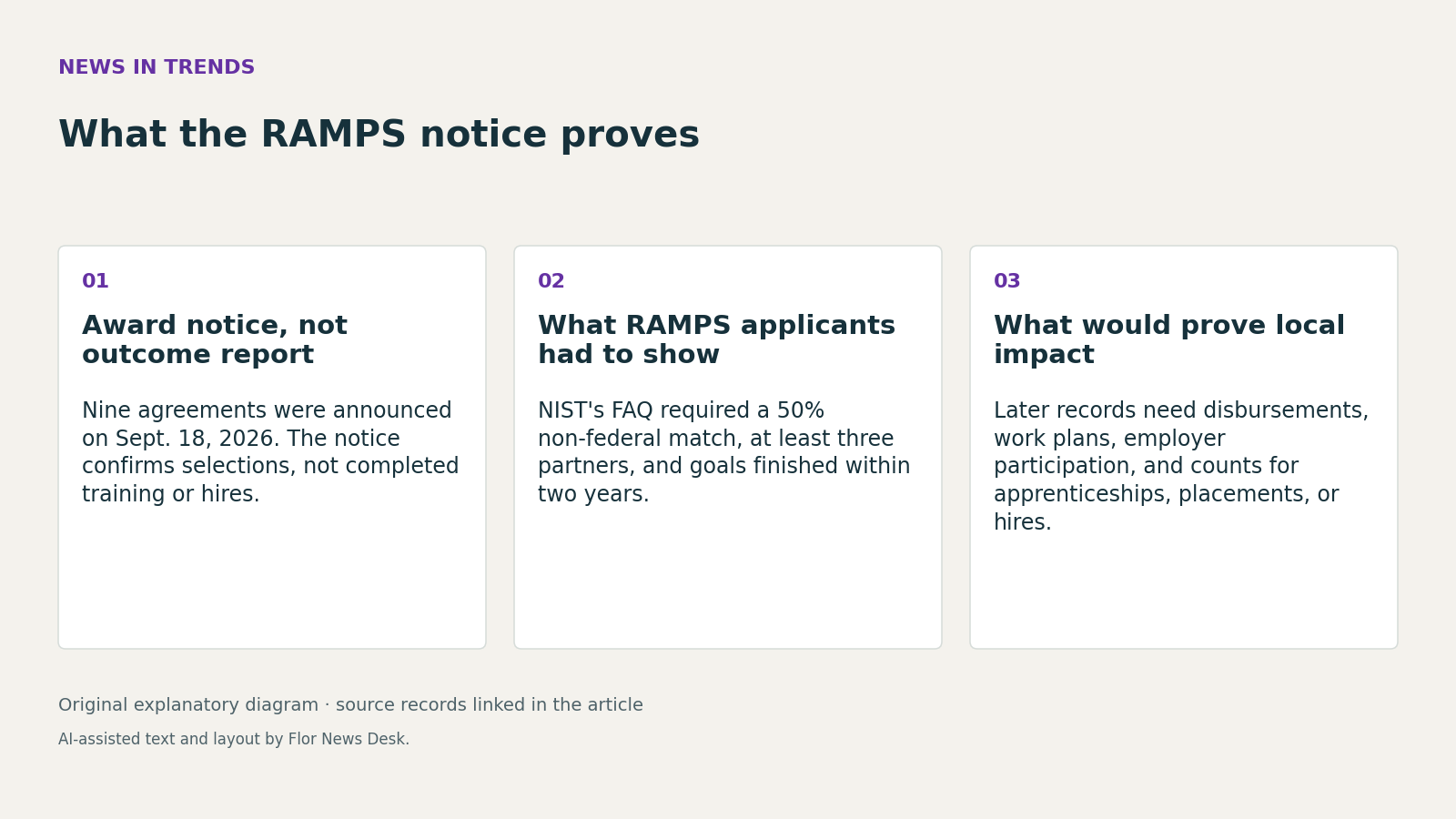
NIST changed the federal map of cybersecurity workforce funding on September 18, 2026, when it announced nine new RAMPS, or Regional Alliances and Multistakeholder Partnerships to Stimulate Cybersecurity Education and Workforce Development, cooperative agreements totaling more than $1.7 million across eight states. The notice said those awards bring the program to 55 communities in 26 states, while NIST’s background page still points readers to an interagency report on the initial five pilot RAMPS communities. What the current record does not establish is whether money has been disbursed, which employers will hire from these pipelines, or whether any local effort has already produced placements or hires. NIST announcement RAMPS communities
The recipients named on September 18 are Florida Atlantic University ($200,000), Kentucky Community and Technical College ($129,311), the National Association of State Energy Officials ($200,000), New Mexico Highlands University ($200,000), the Regents of the University of Michigan ($200,000), Strategic Ohio Council for Higher Education ($199,995), the University of Houston ($199,735), the University of Tennessee ($199,714), and Wright State University ($199,889). Because NIST’s FAQ set a ceiling of $200,000 per project, the pattern matters: most awards sit at or near the maximum, which makes these look less like large operating subsidies and more like seed-scale regional interventions. NIST announcement RAMPS NOFO FAQ
What these awards are supposed to buy is narrower than a broad claim about solving the cybersecurity labor gap. NIST says RAMPS is meant to align local business and nonprofit workforce needs with education and training providers using the NICE Workforce Framework for Cybersecurity. The same records say projects may involve curriculum development, internships, apprenticeships, hands-on projects, workshops, boot camps, competitions, or hackathons. That is a plan for coordination and pathway-building, not proof that employers have already changed hiring behavior. NIST announcement RAMPS communities
The FAQ adds the constraints that will shape whether these projects travel beyond planning. It says the 2026 competition closed on May 28, 2026; applicants had to form multistakeholder partnerships with at least three partners, include at least two letters of commitment from non-applicant entities, keep the focus local, state, or regional rather than national, provide non-federal matching funds equal to or greater than 50% of the federal share, and plan to complete goals within two years. The available NIST pages identify the instrument as a cooperative agreement, but they do not lay out the full legal mechanics or agency role after award, so readers should not infer procurement-style deliverables from these summaries alone. RAMPS NOFO FAQ NIST announcement
There is also a telling gap between the competition rules and the final announcement. The FAQ, updated June 10, 2026, said NIST expected to make up to 16 new awards and still described September 2026 awards as a future milestone. By September 27, 2026, that future tense is a stale expectation, not evidence of what happened after selection. The September 18 announcement names nine awards, but the available records do not explain whether the difference reflects competition results, budget choices, or some other factor. RAMPS NOFO FAQ NIST announcement
So the next documents matter more than the headline. The September 18 notice is not the underlying award file, and the background page is not a results report. To judge whether RAMPS changed local opportunity, later evidence would need to show executed work plans, actual disbursements, named employer participation, and counts for learners, apprenticeships, placements, or hires. Until those records appear, the strongest claim supported by the source record is limited but meaningful: on September 18, 2026, NIST selected nine regional partnerships for modest, matched cybersecurity workforce projects. Whether that becomes measurable labor-market change is a separate question the current documents cannot answer. NIST announcement RAMPS communities