
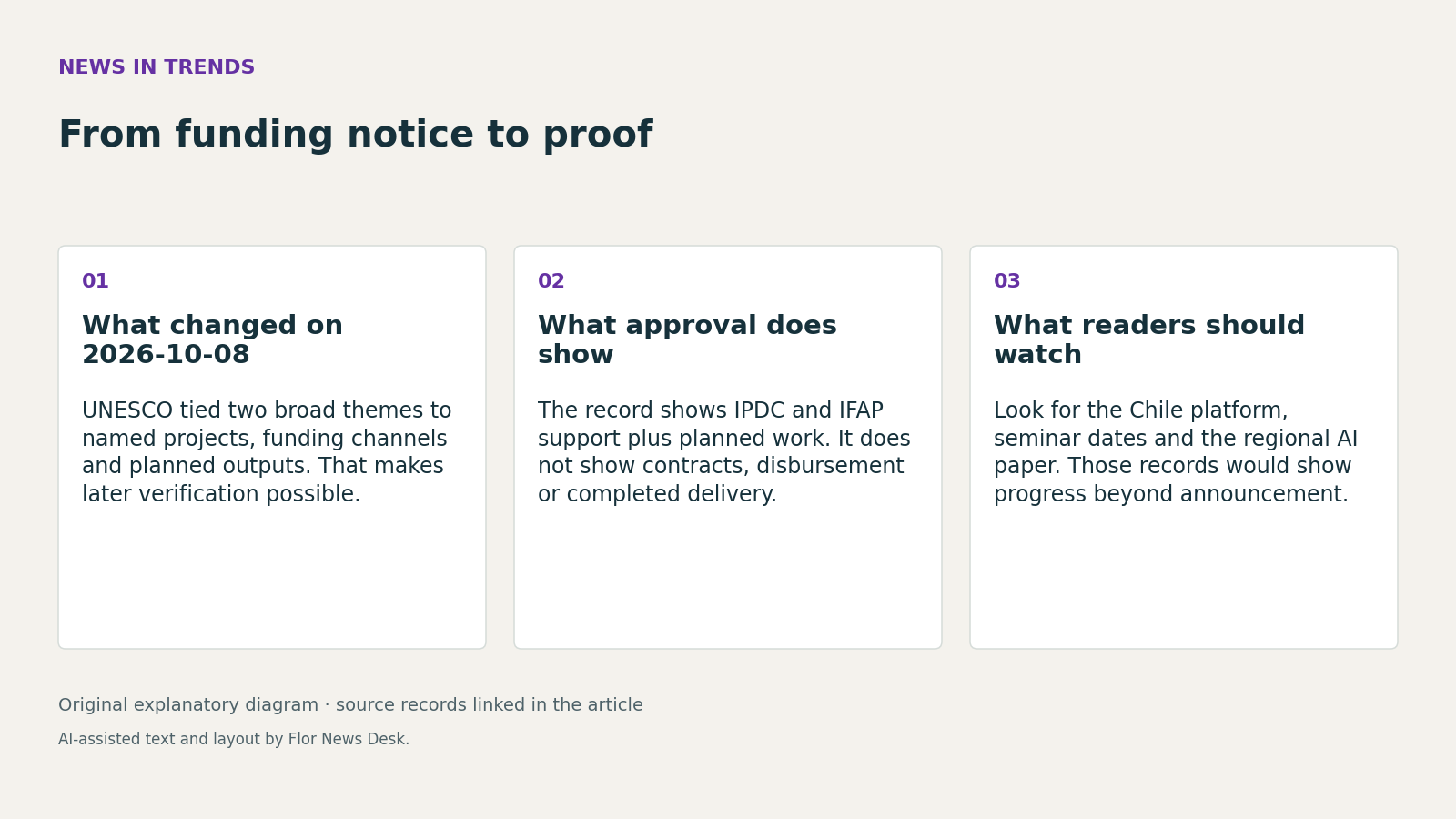
UNESCO Santiago’s 2026-10-08 funding notice, updated 2026-10-27, is bureaucratic news with a practical consequence. The office said it was moving ahead with two supported projects: one on journalist safety in Chile and one on critical literacy about artificial intelligence in education across Latin America and the Caribbean. The shift is not that UNESCO suddenly cares about these themes. It is that the public record now ties them to named programmes and promised outputs that outsiders can later test against reality. UNESCO Santiago notice
For journalist-safety monitoring, that specificity matters. UNESCO says the Chile project was approved by the Bureau of the International Programme for the Development of Communication on 2025-06-19 and will create a method for recording attacks, assemble incident data from Chile since 2020, and publish a disaggregated platform. UNESCO also says the plan includes research on women journalists’ safety and a target that women make up at least 60% of direct beneficiaries. UNESCO Santiago notice
As of 2026-11-03, though, the same record stops well short of proof of delivery. UNESCO’s post does not disclose a funding amount, a disbursement schedule, contracts, who will run or audit the platform, or when any dataset will be public. A public methodology can be challenged and checked; an abstract commitment cannot. That is the core distinction here: approval and planned implementation are documented, while completion, governance and measured impact are not. UNESCO Santiago notice
The AI project makes the same point in a different policy arena. UNESCO says an initiative on critical literacy about AI in education was selected for 2026 support from the Information for All Programme and will be implemented through the Observatory on Artificial Intelligence in Education for Latin America and the Caribbean, with seminars planned in Montevideo and Santiago and a regional evidence document on media and information literacy and AI in education. UNESCO Santiago notice The Observatory page, published 2026-04-01, helps explain why UNESCO is using that vehicle: the office describes it as a regional platform connecting 33 ministries of education with universities, research centres, teachers and partners around evidence, capacity-building and ethical, inclusive AI in education. Observatory page
That background still does not turn planned outputs into accomplished ones. The Observatory description predates the later funding announcement, so it cannot by itself establish that the seminars were held or the document finished. The same caution applies to UNESCO’s general page for the International Programme for the Development of Communication. UNESCO presents the programme as a long-running media-development fund, says it has channelled more than USD 120 million to over 2,300 projects in more than 140 countries, and lists journalist safety among its areas of action, but that page is context, not a Chile disbursement record. International Programme for the Development of Communication
That is why this looks less like a victory lap than an accountability marker. Readers can now check for the Chile methodology, platform and women journalists study, plus seminar schedules and the regional AI paper. If those records appear, UNESCO Santiago’s October announcement will look like the start of implementation rather than a standalone notice. Until then, the documented change is narrower but still important: funding-backed commitments have become specific enough to verify. UNESCO Santiago notice
Read our editorial standards or send a correction to the editorial desk.