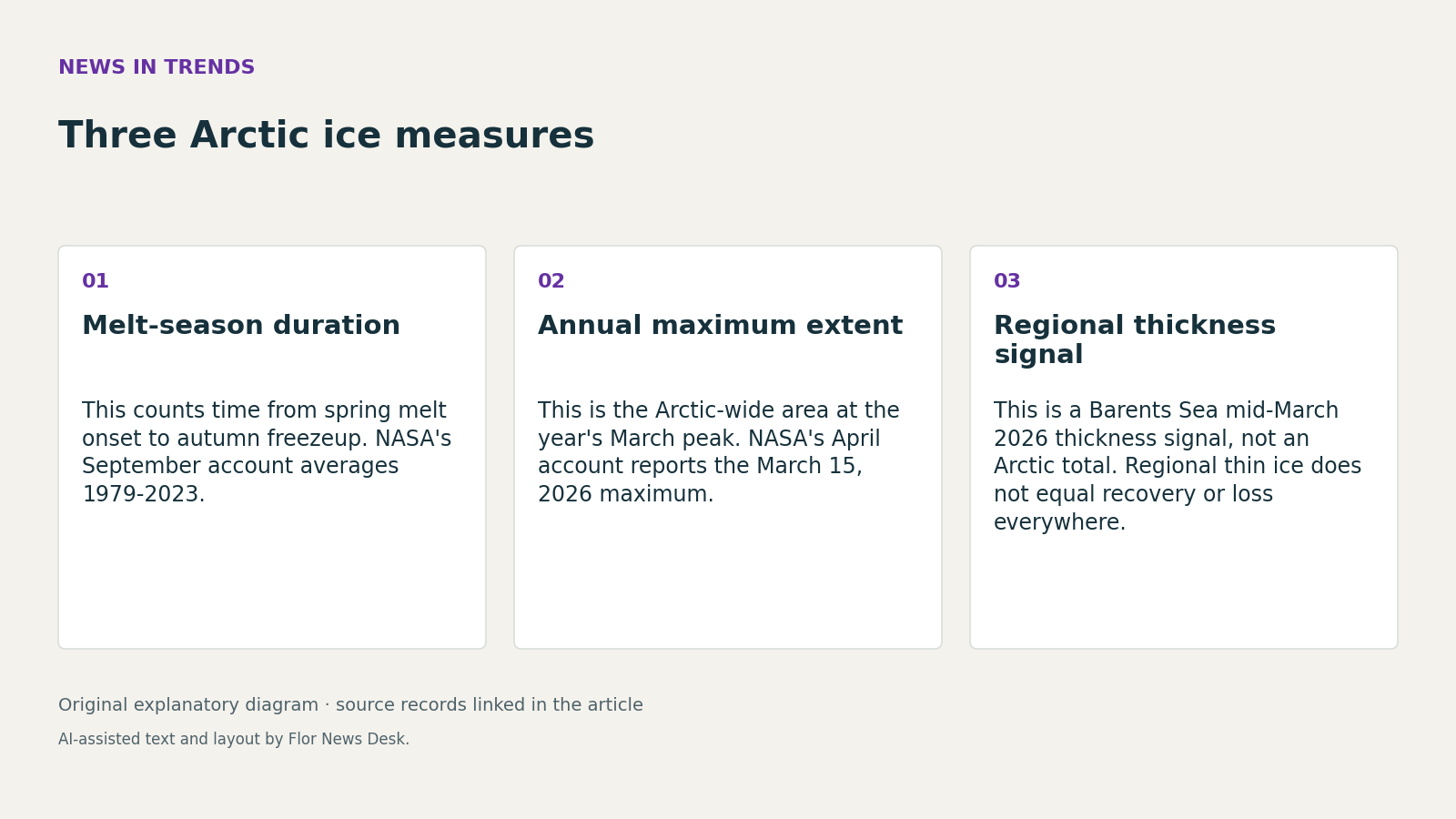
On September 21, 2026, NASA Earth Observatory described a NASA-led study that used satellite observations from 1979 through 2023 to identify when Arctic sea ice began melting in spring and froze again in autumn. NASA says the average melt season is now about 40 days longer than it was in 1979, but that most of the increase happened before 2010; since 2010, the average duration has stayed relatively unchanged even as year-to-year variability remained large. NASA melt-season account
That finding answers a narrower question than whether Arctic sea ice has recovered. Melt-season length is a timing measure: the interval between melt onset and freezeup. NASA says the study found the earlier lengthening was driven mainly by later freezeup rather than earlier spring melt. NASA melt-season account By itself, a plateau in that interval does not show that Arctic sea ice returned to an earlier state. In analytical terms, a stable calendar measure is not the same thing as stable ice coverage across the ocean, or stable thickness in any one region.
NASA’s April 3, 2026 account looked at a different slice of the system. It says Arctic sea ice reached its annual maximum extent on March 15, 2026, at 14.29 million square kilometers, tying the lowest annual Arctic maximum observed since satellite monitoring began in 1979. The same page identifies the Barents Sea as a key contributor and attributes a mid-March 2026 report of very thin Barents sea ice to Nathan Kurtz of NASA’s Goddard Space Flight Center using ICESat-2 data. NASA Barents Sea account Those are important observations, but they are not a direct rerun or rebuttal of the September study. One is an Arctic-wide annual maximum plus a regional thickness observation in March 2026; the other is an Arctic-wide average duration record ending in 2023.
The dates matter as much as the metrics. The September 21 account does not establish melt-season conditions for 2024, 2025 or 2026 because its observation window ends in 2023. NASA melt-season account The April 3 account, meanwhile, describes March 2026 conditions and does not supply a September 2026 ice-extent reading. NASA Barents Sea account So a March 2026 low maximum is not evidence that the post-2010 duration plateau was false, and the duration plateau is not evidence that the March 2026 maximum was unimportant. Each record is scoped to a different question.
The causal language in the two accounts also stays narrower than any claim that the Arctic has stopped changing. NASA says the melt-season researchers examined the Arctic energy balance and presented the post-2010 stability as potentially temporary, not settled. NASA melt-season account The April page says cited studies link Barents sea-ice losses to large-scale atmospheric circulation, while changes in the Sea of Okhotsk are described as more influenced by local weather. NASA Barents Sea account Read together, those points argue for caution: timing, extent and thickness need not move together or for the same reason.
The most useful takeaway is that these NASA pages are complementary, not contradictory. As sourced, one says the average Arctic melt season stopped lengthening after about 2010 despite continued variability; the other says the Arctic’s March 15, 2026 maximum tied the satellite-era low and that Barents ice was unusually thin in mid-March. NASA melt-season account NASA Barents Sea account Neither page establishes September 2026 ice conditions, and neither justifies saying the Arctic stopped warming or that the ice recovered.