NASA’s September 16 account of a purple aurora starts with a tempting mistake: treating color as if it were a full atmospheric measurement. NASA says the published image was acquired on September 7, 2026, from the International Space Station while it was above Kyrgyzstan, and that the released version was cropped, enhanced to improve contrast, and cleaned of lens artifacts. That makes it a processed visual record, not a raw instrument readout, but NASA still presents it as a photograph of a real auroral display rather than an invented scene. NASA Earth Observatory image account
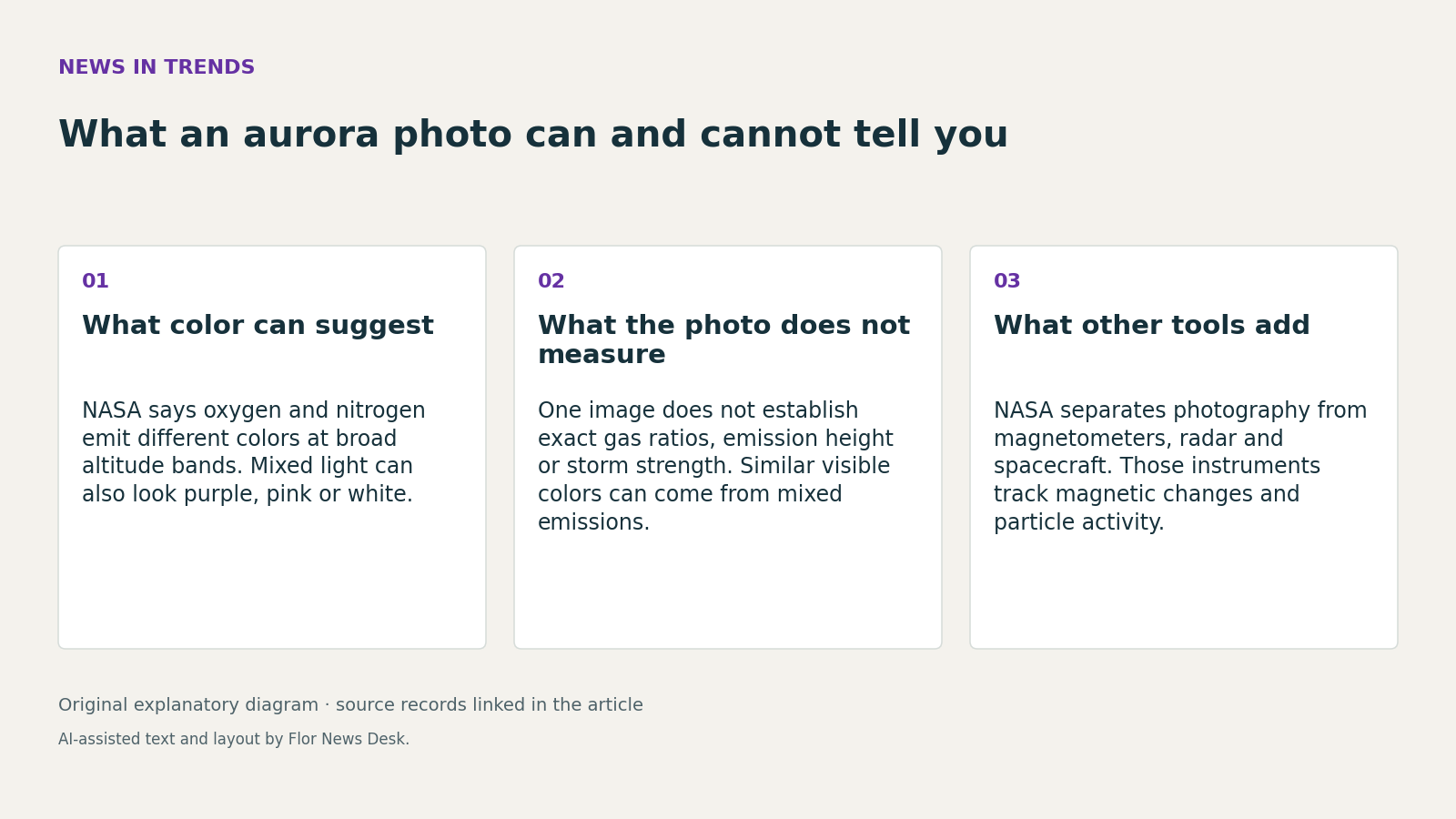
NASA’s explanation of the light itself is narrower than many readers may assume. In both the September 16 image account and NASA’s general aurora overview, the agency says auroras form when energetic particles excite oxygen and nitrogen in the upper atmosphere, and those atoms or molecules release energy as light. NASA says green is commonly associated with oxygen at lower auroral heights, red with oxygen higher up, and some blue or pink tones with excited nitrogen; it also says light from different gases can visually mix, producing purple, pink, or white appearances. NASA Earth Observatory image account NASA aurora overview
That is why the color in this image is a clue, not a verdict. A purple-looking aurora can mean the camera captured overlapping emissions that the eye reads as a blended color, not a single neat chemical label. NASA’s own material supports only broad possibilities: which gases may have contributed, and at roughly what altitude bands some of those emissions often occur. It does not turn one photograph into an exact statement about gas proportions, a precise emitting height for each streak, or a full map of the atmosphere at that moment. NASA Earth Observatory image account NASA aurora overview
The documented editing matters here because it clarifies what kind of evidence readers are seeing. Cropping changes framing. Contrast enhancement can make structure easier to see. Removing lens artifacts cleans up the published image. None of those steps, as described by NASA, establish that the aurora was fabricated, and none convert the image into a calibrated atmospheric measurement either. They sit in a middle category familiar to science communication: a cleaned and presented observation whose scientific meaning still depends on context outside the pixels. NASA Earth Observatory image account
NASA also gives that outside context, but from a different evidentiary lane. The September 16 page says the aurora was linked to a high-speed solar-wind stream from a coronal hole plus lingering effects from multiple coronal mass ejections, and says those interactions caused minor G1 geomagnetic storms, citing NOAA’s Space Weather Prediction Center through NASA’s account. That is an institutional explanation of the event’s space-weather setting. It is not something a viewer can read directly from purple tones in a single frame. NASA Earth Observatory image account
NASA’s broader aurora overview makes the separation clearer by listing other tools researchers use: magnetometers for changes in Earth’s magnetic field, radar networks for upper-atmosphere particle activity, plus all-sky imagers, scientific balloons, sounding rockets, and spacecraft. The practical lesson is simple. A photograph can show that an aurora was visible, where it was seen, and how its light looked after documented presentation edits. It cannot, by itself, replace the magnetic-field and particle observations NASA says are needed to understand the event more completely. NASA aurora overview