On August 4, 2026, NASA highlighted a Webb observing mode that sounds backward on first read: instead of using the whole telescope aperture, it places a mask with several small openings into the light path. NASA says Webb does this through NIRISS, and the blog’s prototype illustration shows seven hexagonal pinholes. That immediately raises the useful question: why would an observatory prized for gathering faint light choose to block so much of it? (NASA blog, August 4, 2026)
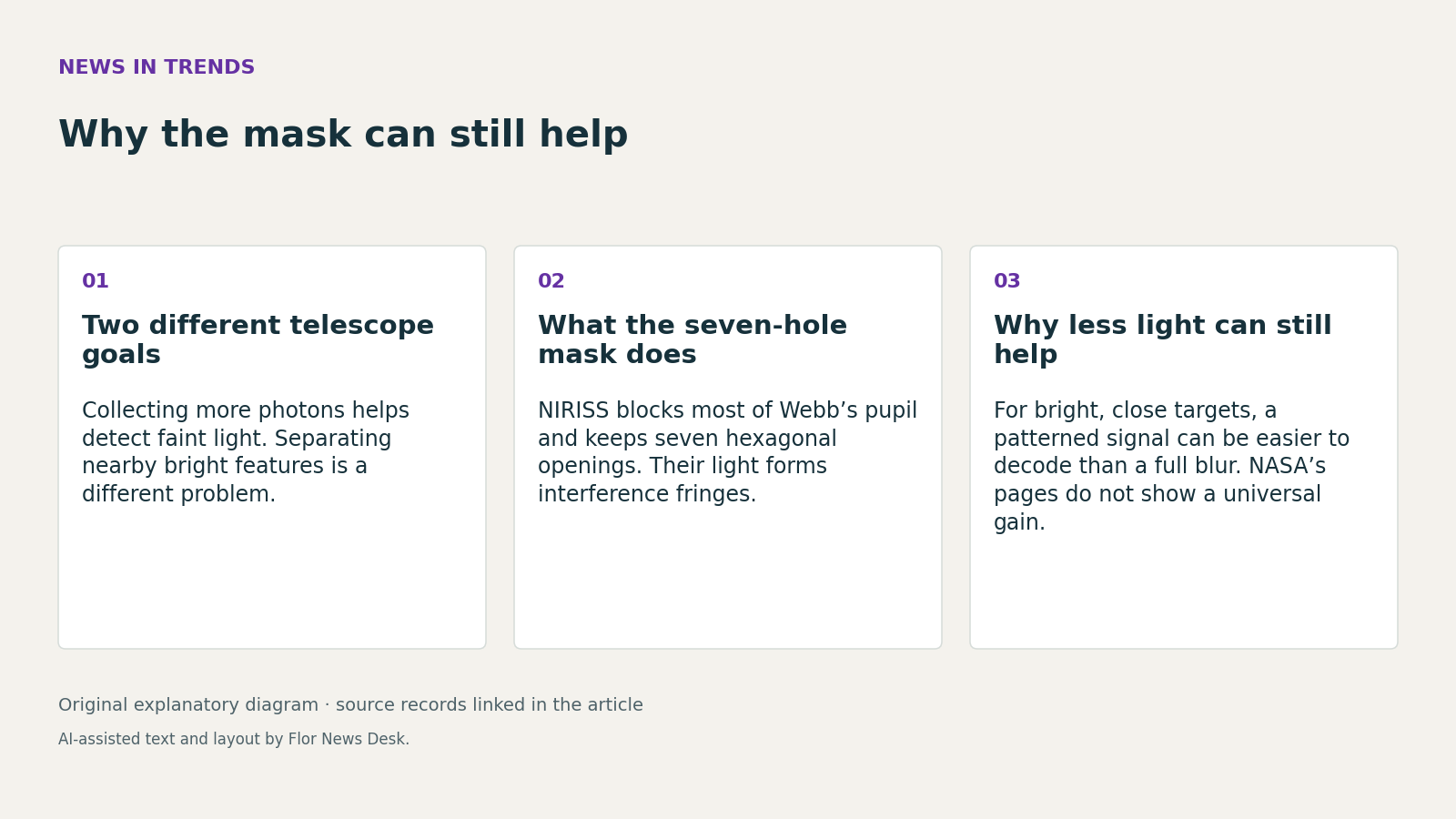
The answer starts by separating two goals that are often blurred together in casual telescope talk. One goal is photon collection: getting enough light to detect something dim. Another is angular separation: telling whether nearby bright features are actually distinct. An older NASA background page, with no visible publication date in the retrieved record, says NIRISS is Webb’s only instrument capable of aperture masking interferometry, and says the mode is used to separate light from bright objects that are close together in space or on the sky. The same page says only light passing through the mask’s seven hexagonal holes reaches the detectors. (NASA FGS/NIRISS page)
That makes the trade-off easier to see. If the main question is whether a very faint source can be detected at all, blocking light is plainly a cost. If the question is whether two bright contributors are crowding each other, the pattern carried by the remaining light can matter more than the total count. NASA’s August 4 post says light passing through the holes produces interference fringes on the NIRISS detector, and that scientists reconstruct images by comparing observed fringe patterns with simulated models. In analytical terms, the mask narrows the flow of light so the directional information can be decoded in a more structured way for certain targets. (NASA blog, August 4, 2026)
What this does not mean is just as important. The source record here does not show Webb gaining physical collecting area, and it does not provide a universal factor by which detail improves. NASA’s background page describes a metal plate placed in front of the detectors; by NASA’s own account, the rest of the incoming light is blocked. So language about an effective aperture or interferometric behavior should not be turned into a claim that Webb somehow becomes a larger light bucket. This is a special-purpose observing mode with an explicit compromise. (NASA FGS/NIRISS page)
A hypothetical observing question helps. Imagine two bright points so close together that an ordinary image blends them into one swollen patch. In that case, sacrificing photons could still make sense if the surviving fringe pattern preserves cleaner clues about whether there are two sources. Now imagine a faint, diffuse glow instead. The same mask would remove light, and these NASA records do not establish that the trade helps in that case. The documented scope is narrower: bright objects that are close together. (NASA FGS/NIRISS page)
NASA’s August 4 post illustrates the method with WR 137, PDS 70 and Jupiter’s moon Io, which shows the mode being applied to real targets rather than left as a purely conceptual capability. But those examples do not prove that aperture masking is the best choice for every Webb observation, and the blog does not quantify the sensitivity penalty or provide a general separation limit. The available record explains the logic of the tool more clearly than it supports any broad ranking of its performance. (NASA blog, August 4, 2026)
The practical takeaway is that telescope performance is not a single slider called power. NASA’s own descriptions separate the advantage of collecting more light from the advantage of encoding angular detail in a form scientists can model. In NIRISS, Webb sometimes accepts less light so that close, bright structure can become easier to sort out. That is a more precise and more useful claim than saying the telescope simply sees more. (NASA blog, August 4, 2026; NASA FGS/NIRISS page)