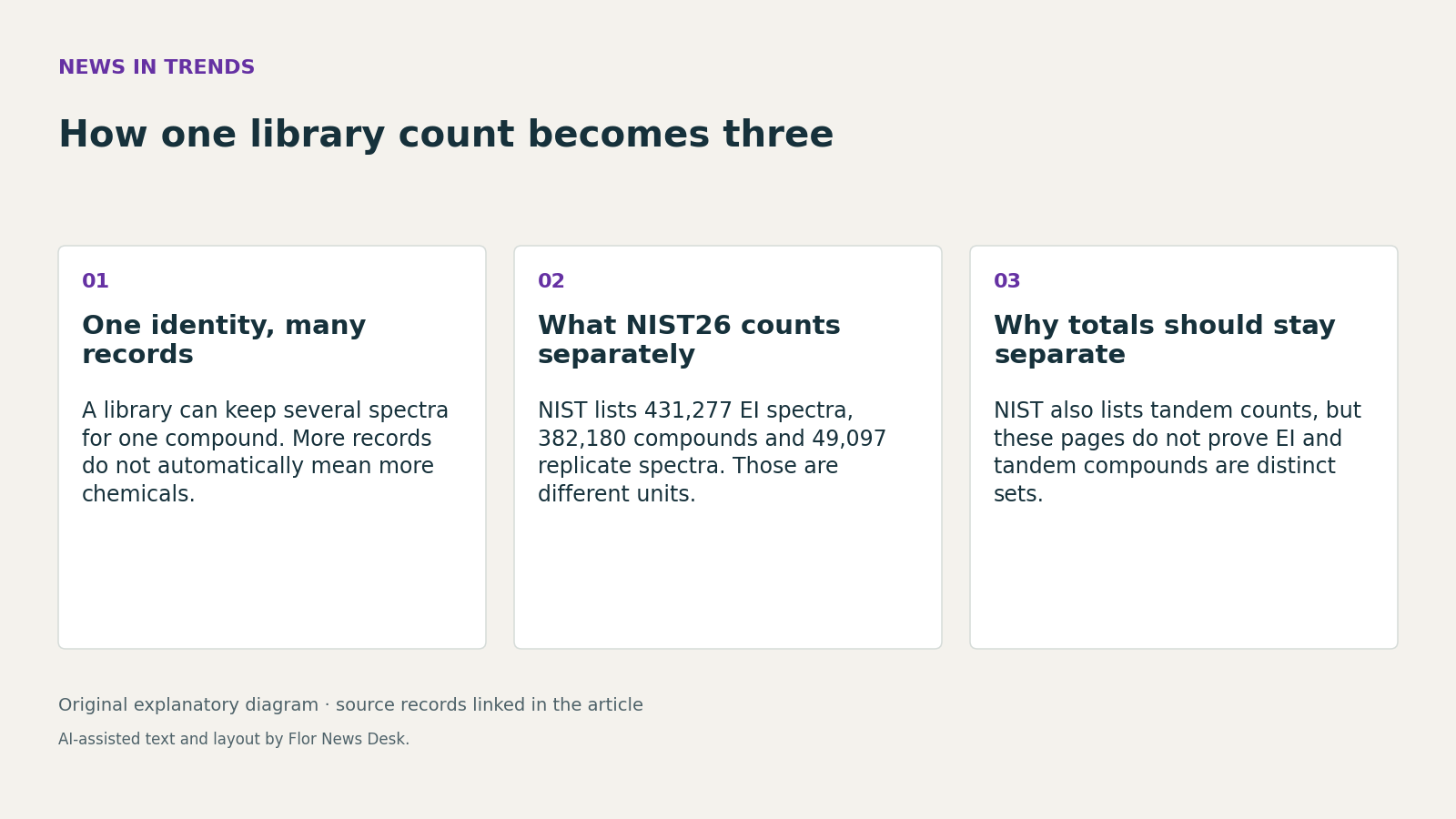
On June 9, 2026, the National Institute of Standards and Technology said it had expanded Standard Reference Database 1A, its mass spectral library. The part worth slowing down over is the counting. One headline number can describe chemical identities, while another describes measured records for those identities. NIST’s technical NIST26 page, updated June 10, makes that distinction explicit for the Electron Ionization library: 431,277 spectra, 382,180 compounds and 49,097 replicate spectra. June 9 announcement NIST26 technical page
Those figures are not rival totals. A compound count answers how many distinct chemical identities are represented. A spectrum count answers how many EI fingerprint records are stored. A replicate spectrum, by NIST’s labeling, is an additional EI record attached to a compound already represented in the library, not evidence of a new compound. That is why record counts can exceed identity counts without contradiction. NIST26 technical page
A hypothetical example makes the logic clearer. Imagine a tiny library with compounds A, B and C. If A has one EI spectrum, B has one, and C has three measured EI spectra kept as separate records, the library contains three compounds but five spectra. Two of those spectra are extra measured representations of C, not two extra chemicals. That is the same counting distinction the NIST26 EI page describes at national-reference scale. NIST26 technical page
That distinction matters because library expansion can mean two different things. NIST says the EI library in NIST26 added about 35,000 compounds and now totals more than 382,180 compounds, while the technical page gives the more exact increase as 35,080 over the 2023 release. Those statements describe broader identity coverage: more chemicals have at least one library entry. The separate tally of 49,097 replicate spectra describes thicker representation of identities already present. A larger library can therefore mean more chemicals, more measurements of known chemicals, or both. June 9 announcement NIST26 technical page
The same caution applies across the package’s two main collections. NIST says NIST26 has an EI Library and a Tandem Library. The June 9 announcement says the tandem collection totals 68,635 substances, and the technical page lists 68,635 compounds, 567,114 precursor ions and 3.2 million spectra. But those pages do not say the EI and tandem compound lists are disjoint. So adding 382,180 and 68,635 as though they produced one verified unique-chemical total would claim more than these records support. June 9 announcement NIST26 technical page
The limits of the source record are part of the story. Both pages are NIST descriptions of the release, not an independent audit of the licensed database, and neither page provides a universal identification-accuracy figure or real-world outcome data. The June 9 announcement also says the library is purchased through instrument manufacturers or other distributors, which is different from saying it is freely available. As of 2026-09-22, these records document a June 2026 release and later June updates, not a new September launch or a measured September outcome. June 9 announcement NIST26 technical page