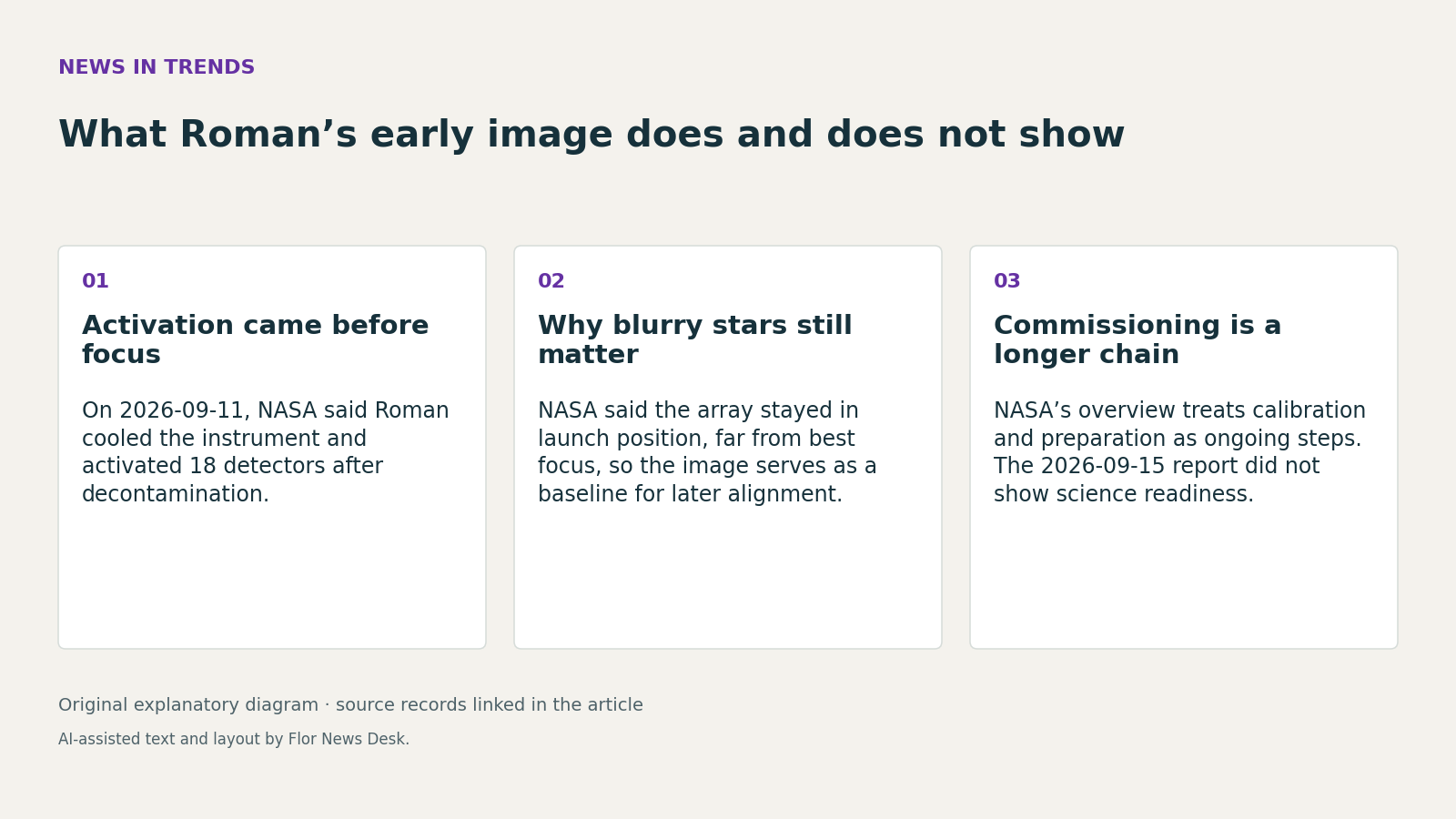
NASA’s 2026-09-15 update on the Nancy Grace Roman Space Telescope reported a milestone that is easy to overread: the Wide Field Instrument recorded its first starlight, but NASA also said the detector array was still stowed in its launch configuration, far from best focus. That makes the image important as evidence that the instrument is coming alive, not as a final test of what Roman can resolve in science operations (NASA instrument report).
The timing inside the report matters. NASA said the instrument had just come through a 10-day decontamination period at minus 85 degrees Fahrenheit, then on 2026-09-11 the heater was turned off, the Wide Field Instrument cooled to minus 225 degrees Fahrenheit, and Roman’s 18 infrared detectors were activated. In that sequence, the first useful question is not whether the stars look sharp. It is whether the detectors respond as expected under a known setup. An out-of-focus field can do that job because it gives engineers a baseline before later alignment changes are made (NASA instrument report).
That is why the image should not be treated as either a triumphal beauty shot or a sign of trouble. NASA’s report says engineers were still testing the element wheel and the focus mechanism while the detectors continued cooling toward about minus 300 degrees Fahrenheit. If focus hardware is still being exercised, then detector activation alone cannot establish the telescope’s final image quality. Pixel count does not answer that question by itself either. Sharpness depends on where the optics and detectors are positioned when light is measured, and NASA said this measurement was taken far from best focus (NASA instrument report).
The broader commissioning record points in the same direction, but it has to be handled carefully. NASA’s overview page defines commissioning as the period when Roman systems are turned on, adjusted, calibrated, and prepared for science during the trip to Sun-Earth Lagrange Point 2. It also says the schedule is subject to change, and that Roman’s planned halo orbit at L2 offers steadier conditions and less thermal interference for infrared observations. That context helps explain why cooling, focusing, and calibration are separate stages rather than one all-at-once switch (NASA commissioning overview).
What the overview cannot do is update the mission’s status on its own. The page, as retrieved on 2026-09-22, includes relative future wording about near-term steps. So it works as background on the intended sequence, not as proof that those steps were still pending or already finished on 2026-09-22. For current status, the firmer record here is the dated 2026-09-15 instrument report, which said fine-guidance activation and observatory focusing were still ahead, and that first science images were expected by early 2027. That was NASA’s expectation on 2026-09-15, not an achieved result (NASA instrument report; NASA commissioning overview).
So the most useful way to read Roman’s first starlight is as a commissioning checkpoint with a deliberately limited meaning. The documented change is real: the primary instrument has begun detecting stars after activation and cooling. But the same NASA records separate that accomplishment from later alignment, fine guidance, calibration, and science readiness. The blurry image is not the telescope’s final answer. It is the reference point from which later answers can be measured (NASA instrument report; NASA commissioning overview).