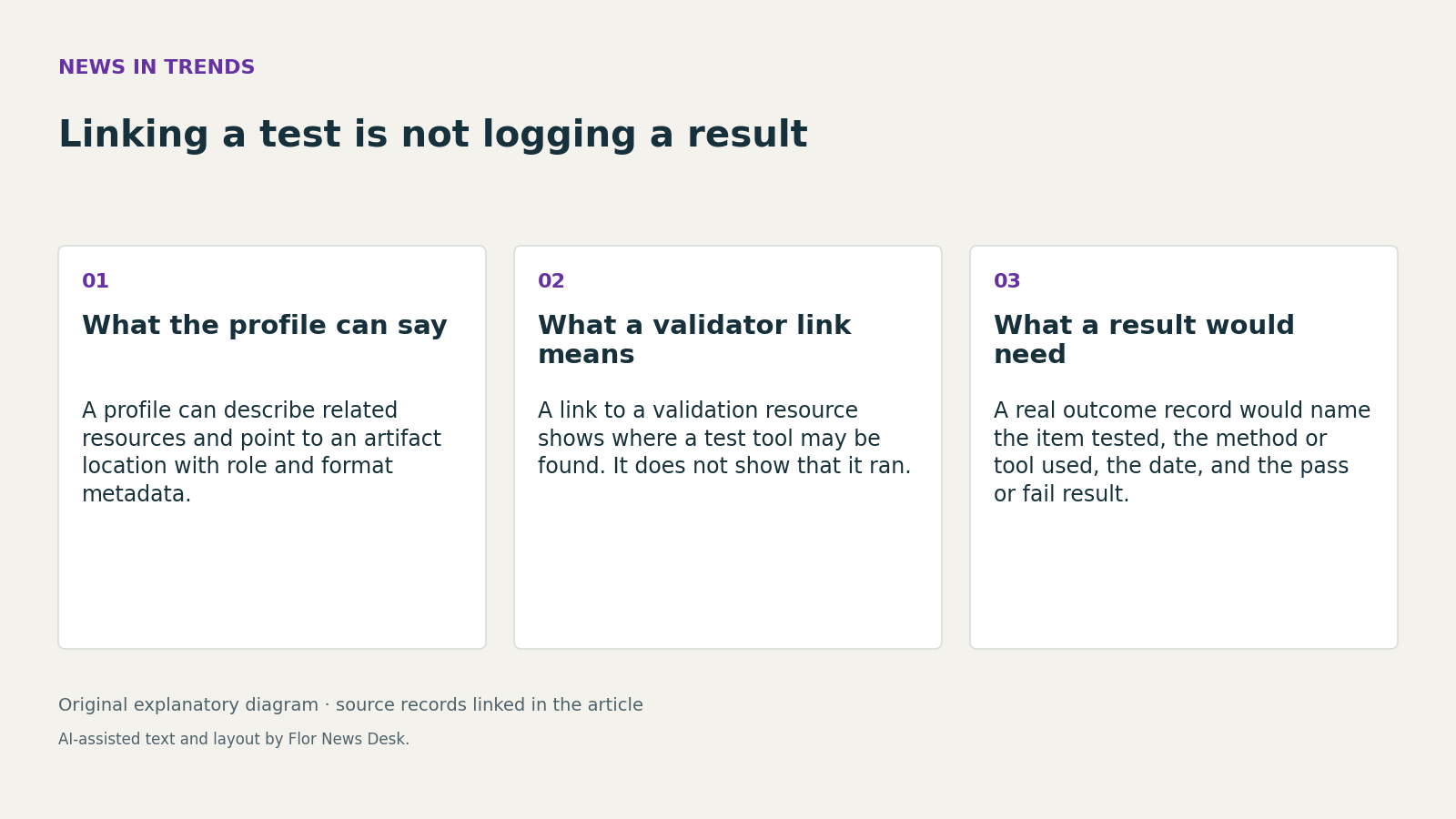
On 20 August 2026, W3C announced a First Public Working Draft for The Profiles Vocabulary, a format for describing profiles of specifications and linking profile-related resources such as guidelines, schemas, term lists and validation tools. W3C announcement That is a useful change in how profile information can be published. It is not, by itself, evidence that any information resource has been checked, passed a test or interoperates with another system.
The dated technical snapshot matters here because it shows what the vocabulary actually models. The 7 September 2026 Working Draft says a profile may connect to a resource descriptor, and that descriptor can identify an artifact location, a role, a file format and what a resource conforms to. Working Draft In plain terms, the draft gives publishers a structured way to say, “this profile has supporting material over here, and here is what kind of thing it is.” That is metadata about a resource. It is not the same thing as a record that the resource was executed.
That distinction is easy to miss because a link to a validator feels close to a test result. The source record does not support that leap. The August announcement says profile descriptions can link validation tools, but it does not report a validator run or any outcome. W3C announcement The September draft likewise supports describing or locating validation-related artifacts, yet the retrieved record contains no evidence that a linked tool was run against a dataset, no pass or fail status, and no implementation result. Working Draft
A hypothetical catalogue entry shows the difference. Suppose a registry says a “City Transit Timetable Profile” has a validation resource, gives that resource a role, lists its format, and points to an artifact URL. That would tell software where a test resource lives and what sort of file it is, which is exactly the kind of discovery the draft is designed to improve. Working Draft But the entry still would not establish that timetable file A was checked on 15 September 2026, with validator version B, under rules C, and received result D. Those are separate facts that would need their own record.
The draft gives another reason not to overread a profile link: it says communities may define for themselves what conformance to their profiles means and how, if they choose, to test for it. Working Draft So even if a validation tool exists and is linked, the draft does not make that tool the universal judge of compliance. A community could treat one schema as a basic syntax check, while requiring additional review or other tests for full conformance. That is analysis based on the draft’s premise that conformance rules are community-defined, not fixed by the vocabulary itself.
Readers should also keep the maturity label in view. The 7 September document is a Working Draft on W3C’s Recommendation track, and its status section says publication does not imply endorsement and the document may change. Working Draft The strongest supported takeaway, as of 22 September 2026, is modest but important: the Profiles Vocabulary can make validation resources easier to find and describe. The source record does not establish that those resources were run, that they produced any result, or that a machine-readable profile entry is proof of a passed test.