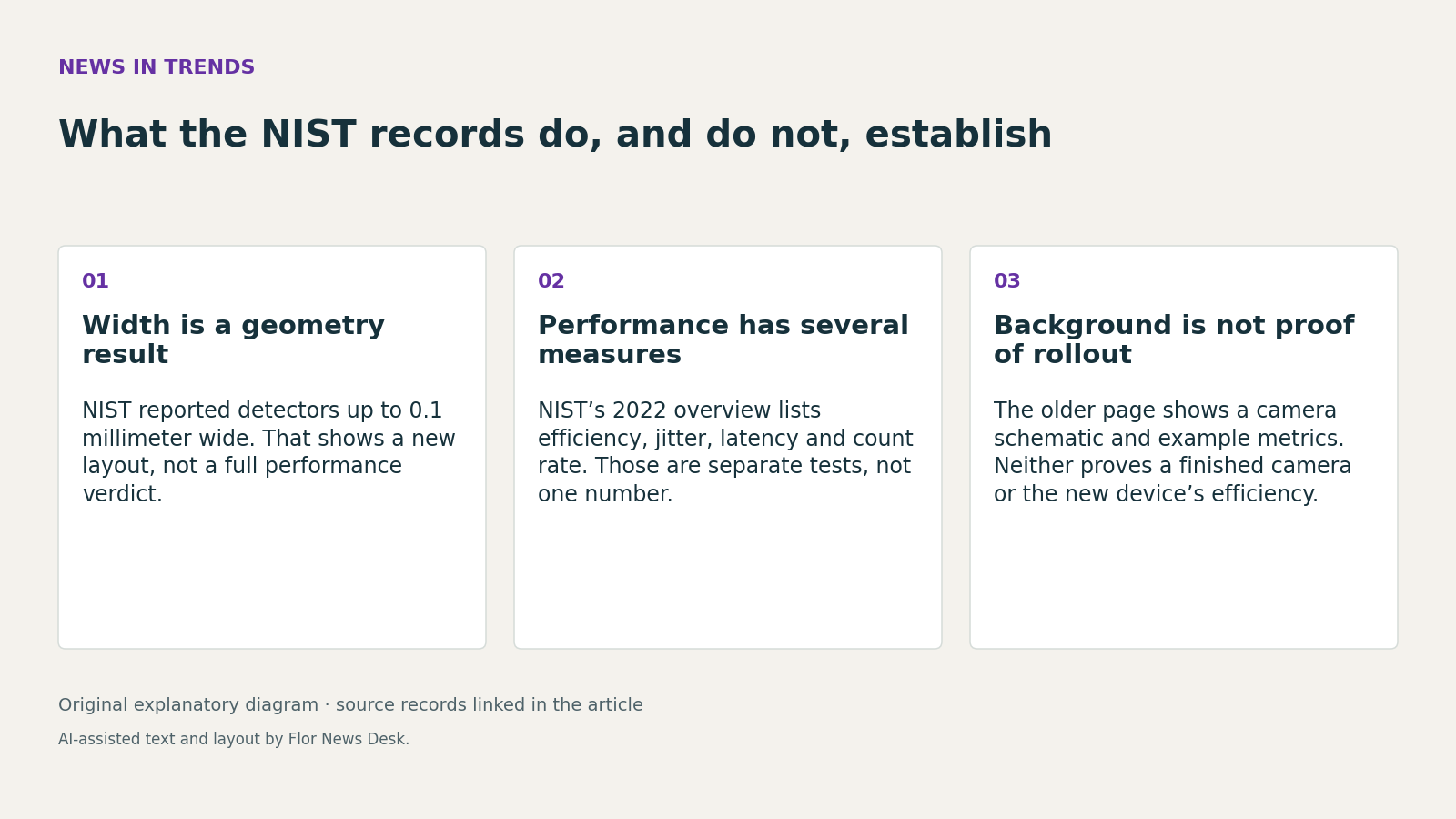
On August 24, 2026, the U.S. National Institute of Standards and Technology said its researchers had reported superconducting nanowire single-photon detectors as wide as 0.1 millimeter, with an Optica paper posted online on August 19, 2026 (NIST news item). That is a concrete fabrication result. It is not the same as proving every performance trait readers may associate with these detectors.
The first distinction is simple: geometry and performance answer different questions. The August 2026 record says typical superconducting nanowire single-photon detectors use wires about 100 nanometers wide, and says the wider design adds superconducting rails to redistribute current and reduce current buildup at the edges (NIST news item). From that, a reader can reasonably conclude that NIST is describing a new device layout and a larger detector width. What the width alone does not tell you is how well the device performs across the many other measurements that matter in photon detection.
NIST’s older detector overview, published on February 4, 2022 and updated on August 24, 2022, makes that broader point directly. It says practical detector performance can depend on detection efficiency, latency, timing jitter, maximum count rate, afterpulsing and, in some cases, photon-number resolution (NIST overview). As analysis, those terms describe different limits: efficiency is about whether a photon is registered at all; timing jitter is about how precisely its arrival is marked; maximum count rate is about how quickly repeated events can be handled. A wider component could be important and still leave those separate questions open.
That is why the tempting shortcut, importing older headline numbers into the new result, does not hold up. The 2022 overview gives example superconducting detector characteristics including 98% or better efficiency, jitter below 3 picoseconds and very low dark counts (NIST overview). But the August 2026 news item itself says it remains unclear whether the wider devices can reach the same 98% efficiency, and that more testing is needed (NIST news item). NIST also says the new devices showed a billion-fold reduction in dark counts, but the news text does not fully specify the comparison point or test conditions, so that claim cannot substitute for a full performance table for the 0.1 millimeter design (NIST news item).
The same caution applies to hardware and application claims. The older page includes a figure labeled as a 100 Megapixel superconducting nanowire single-photon detector camera schematic drawing (NIST overview). A schematic is evidence of a concept being illustrated, not of a manufactured or deployed camera. Likewise, the August 2026 news item discusses areas such as healthcare imaging, astronomy and dark-matter detection as possible implications, not documented end-use results (NIST news item).
So the cleanest reading of the record is narrower and more useful. NIST has described a larger detector geometry, a current-management approach using rails, polarization insensitivity and an unresolved efficiency question for the new wide devices (NIST news item). The 2022 background page explains why that unresolved point matters: single-photon detectors are judged by several measurements, not one (NIST overview). For readers, the takeaway is not to dismiss the August 2026 result, but to classify it correctly. Bigger is a verified design change. Better, in the full engineering sense, still needs separate evidence.