On 2026-09-16, W3C said it had launched the first pilot of a new program to support open-source software projects, with Digital Bazaar contributing the code behind the “Can I VC?” dashboard to W3C. W3C described that first pilot as a community-driven compatibility dashboard for the Verifiable Credentials ecosystem, intended to help participants understand interoperability through community test suites. That is a concrete governance change: code and coordination are being brought into an experimental W3C program, not merely discussed in theory. The announcement does not, however, provide live scores, rankings, audit findings or proof of broad deployment. W3C blog announcement
The easiest mistake is to treat “compatibility” as a verdict on whether a credential should be believed. The source record does not support that leap. The 2025 W3C Recommendation for Verifiable Credentials says a credential is a way to express claims from an issuer, with issuers, holders and verifiers as the core roles. It also separates technical verification from the later decision to rely on a claim. VC Data Model v2.0
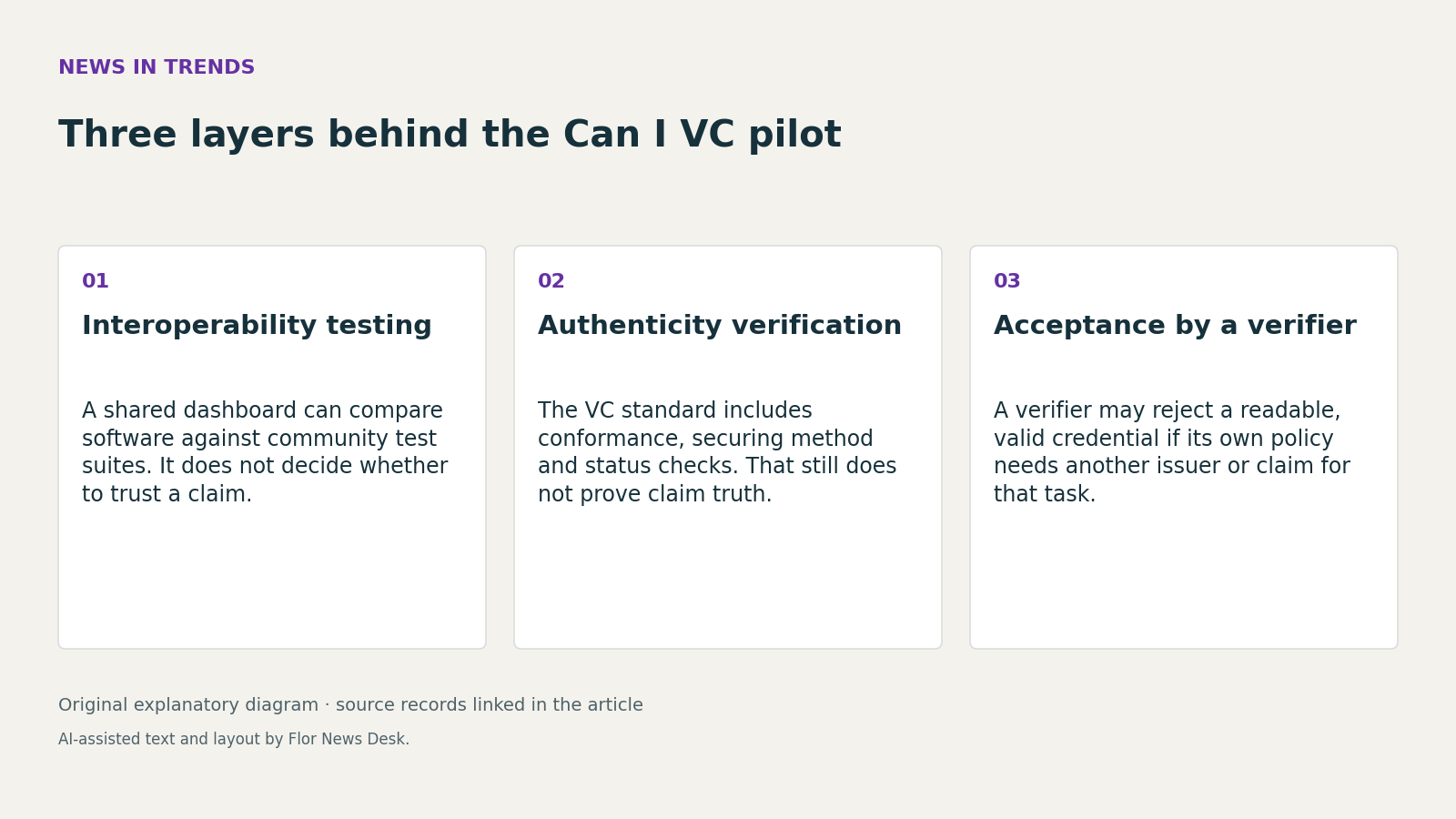
That yields three layers readers should keep apart. First is interoperability testing: whether implementations can consume conforming documents and behave properly against shared tests. The Recommendation says a conforming verifier must consume conforming documents, perform verification checks and report errors for non-conforming ones. W3C’s September 16 post places Can I VC in that neighborhood by tying it to interoperability and community test suites. VC Data Model v2.0 W3C blog announcement
Second is authenticity and current validity. The same Recommendation defines verification as checking whether a credential or presentation is authentic and current, including conformance, the securing mechanism and any status check. That is stronger than “my software can parse this file,” but it still stops short of proving that the underlying claim is true. The standard says so explicitly. VC Data Model v2.0
Third is acceptance for a real purpose. The Recommendation says a verifier applies its own business rules and policies before relying on claims. In plain terms, a technically readable and cryptographically valid credential can still be the wrong credential for the task. Hypothetical example: a venue’s system may be able to read a membership credential and verify that it was issued properly, yet still refuse it for age-gated entry because the venue’s policy requires a different kind of issuer or claim. That is not a software failure. It is a reliance decision. The standard supports that distinction, but does not decide the venue’s rule for it. VC Data Model v2.0
This is why the September 16 pilot is interesting without being magical. A shared dashboard can make implementation disagreements more legible. If two verifier products fail the same community test, developers get a common reference point. If they pass, that suggests some baseline compatibility. But neither outcome establishes universal compatibility, independent security certification or truth of any credential’s claims. W3C’s own blog post does not supply those broader conclusions, and it says only that a second pilot is planned and discussion is expected at TPAC 2026 in October. As of 2026-09-21, that is still a stated expectation, not an established result. W3C blog announcement
So the real significance is narrower and more useful than hype. The May 15, 2025 Recommendation was the standards milestone; the September 16, 2026 announcement is a governance and tooling milestone around open-source support. If Can I VC succeeds, the clearest win would be shared evidence about how software behaves under common tests, while leaving the harder questions of issuer trust, claim truth and policy acceptance exactly where the standard already puts them: with the verifier’s own judgment and rules. VC Data Model v2.0 W3C blog announcement