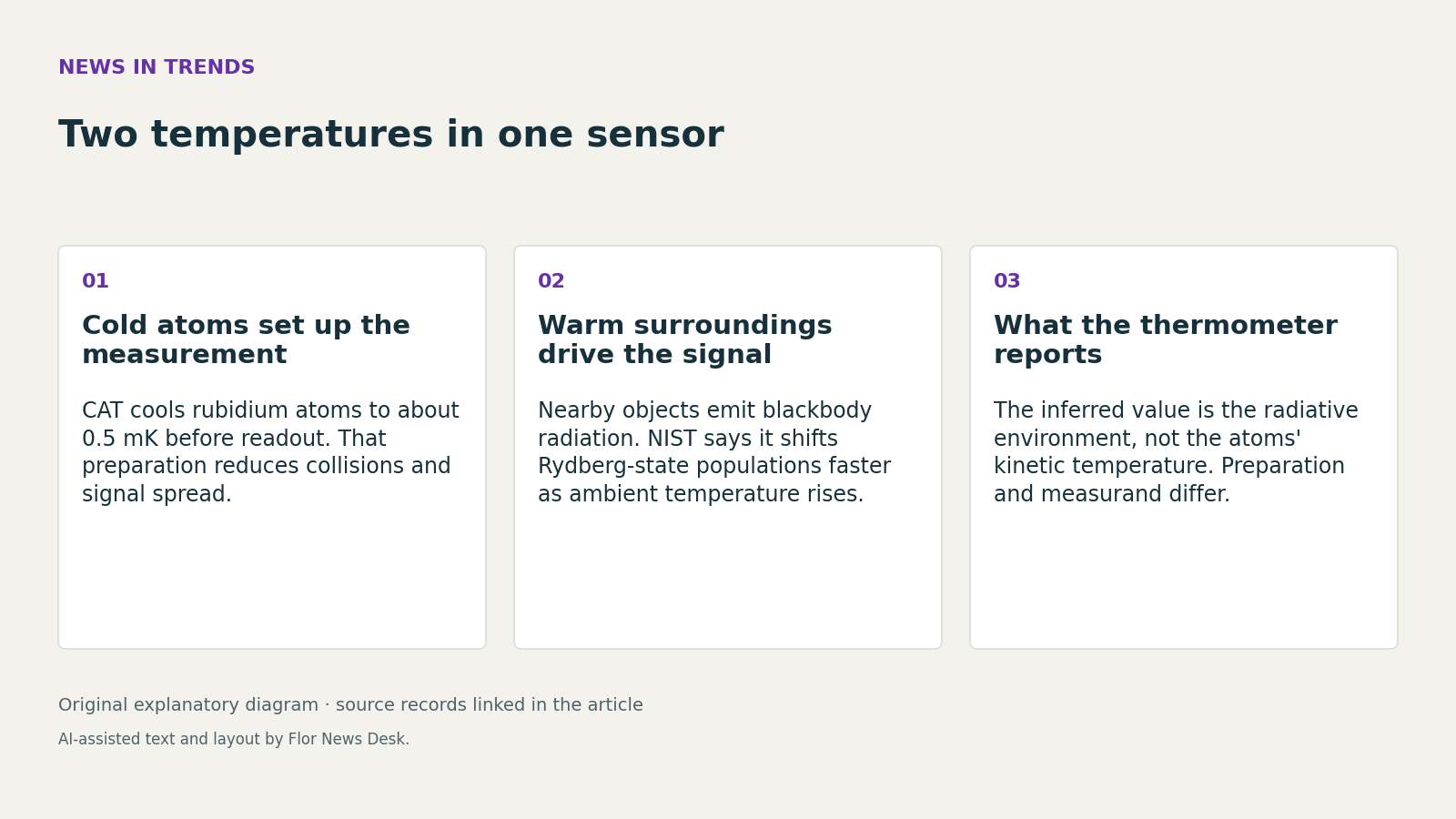
On January 23, 2025, the U.S. National Institute of Standards and Technology described a thermometer that first cools roughly 1 million rubidium atoms to about 0.5 millikelvin, then uses them to infer the temperature of much warmer surroundings. That sounds contradictory only if the sensor’s own temperature is assumed to be the quantity being measured. In NIST’s description, it is not. The environmental signal comes from how surrounding blackbody radiation shifts the atoms among nearby excited states over time, not from the atoms simply reporting their own coldness. NIST news release Atomic Thermometers program page
The cleanest way to read the device is to separate preparation from measurand. NIST’s Cold Atom Thermometer, or CAT, prepares atoms in a controlled state and then watches how the radiative environment perturbs that state. The temperature being inferred is therefore the radiative temperature of the surroundings, expressed through blackbody-driven changes in Rydberg-state populations. The atoms are cold as an experimental condition; the surrounding enclosure is warm as the quantity of interest. NIST news release Atomic Thermometers program page
Why cool the atoms at all? NIST’s March 26, 2025 program page gives two practical reasons: cooling to about 0.5 mK suppresses collisions with ground-state atoms and reduces time-of-flight spread in the selective field ionization signal. Both are about cleaning up the readout. In analysis terms, the cold cloud is part of the instrument design that narrows unwanted motion and interference before the actual sensing interval. It improves how sharply state populations can be distinguished; it is not the temperature the instrument is trying to announce. Atomic Thermometers program page
NIST’s method description reinforces that distinction. In CAT, atoms are driven to a Rydberg level, blackbody radiation transfers some population to nearby Rydberg states, and selective field ionization measures those populations as a function of interaction time. The January 2025 release says the transfer rate rises with ambient temperature. That means the warmer surroundings matter because they alter transition behavior during the measurement window. The reported temperature is inferred from that time evolution. NIST news release Atomic Thermometers program page
A hypothetical example makes the logic clearer. Suppose the atoms were prepared in the same cold way in two otherwise similar enclosures, but one enclosure had a warmer radiative environment. The atom cloud could start at the same prepared kinetic temperature in both cases while the pattern of blackbody-driven state transfer changed between them. That would let the inferred environmental temperature differ even though the preparation step did not. The point is conceptual: one temperature belongs to sensor preparation, the other to the environment acting on the sensor.
The March 2025 program page also matters because it separates CAT from another NIST effort, Compact Blackbody Radiation Atomic Sensor, or CoBRAS. CoBRAS uses a thermal vapor and fluorescence ratios; CAT uses cold atoms in Rydberg states. Mixing those architectures would blur the answer to the reader’s question, because only CAT relies on cooling atoms to reduce collisions and sharpen its state readout. Atomic Thermometers program page
The source record has limits. Both available records are NIST institutional pages from January and March 2025, not independent reviews, and no directly retrieved journal abstract was available in this brief. They support the physical distinction above and record that NIST had demonstrated CAT in a 297 K to 338 K range, while the broader program aimed at 250 K to 400 K. They do not establish what happened after March 26, 2025, whether the project was later deployed, or any September 2026 status beyond NIST’s then-current description of the work as ongoing. Atomic Thermometers program page